


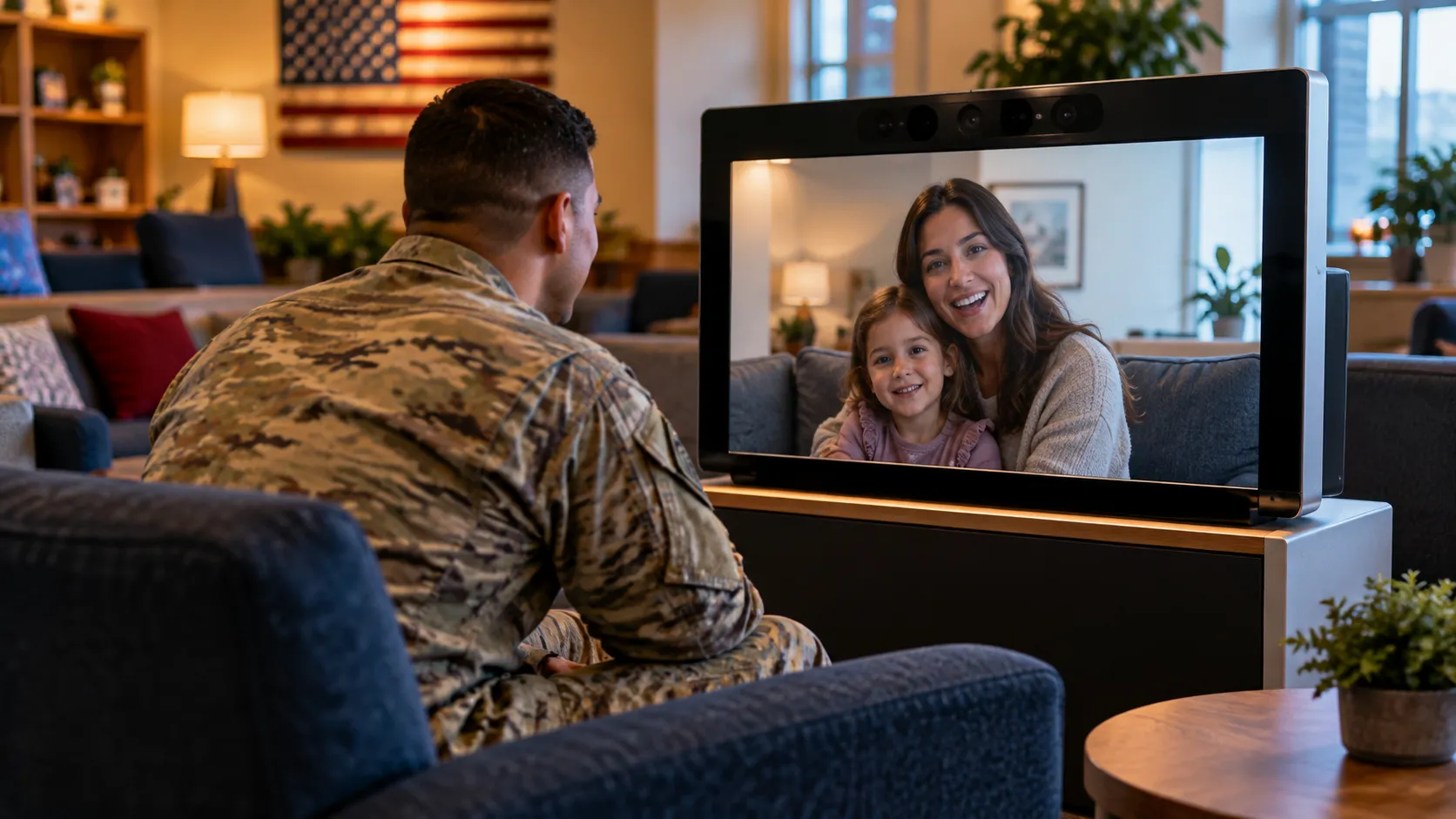
Google and the USO are bringing a 3D video system built for corporate meeting rooms to USO centers worldwide, aiming to let deployed service members see their families in near-lifelike detail instead of on a flat screen. Google Beam is expanding to 20 USO locations globally, the company announced Oct. 26, a significant step beyond the previously announced Poland-Fort Bliss pilot.
What the announcement does not include is measurable outcome data. Google's post does not establish whether the technology improves relationships between deployed troops and their families, although its accompanying documentary series shares individual experiences with the system.
The expansion builds on a pilot that connected Trzebień, Poland, with Fort Bliss, Texas, which began earlier this year. Google has also released a documentary series showing how the program is expanding to connect Grafenwöhr, Germany, with Fort Hood, Texas, according to the Google Blog.
Google first said it planned to bring Beam to USO centers "in the U.S. and around the world" in October 2025, as part of a partnership announced that month. The 20-site rollout is the largest publicly announced expansion of that commitment to date.
From one pilot to 20 sites
The jump from one pairing to 20 locations is the headline, but the announcement leaves the operational picture incomplete. Google has not identified which countries or installations, beyond the locations in Poland, Germany, and Texas, make up the full 20-site count.
How the sites pair up is also unclear. The Poland-Texas and Germany-Texas connections suggest that overseas USO centers can be linked with specific stateside locations. Whether all 20 sites follow that structure, or whether some can connect with multiple partner sites, isn't addressed in the announcement.
Access questions follow close behind. Google hasn't specified whether a family member must visit a USO center equipped with Beam to receive the full 3D experience, or whether alternative arrangements exist for families who live far from participating locations.
The announcement also doesn't explain how sessions are scheduled across time zones or how families can request access.
The USO rollout runs alongside Google's commercial expansion of the same technology. In September, Google said Beam units were shipping to customers across six countries: the US, Canada, UK, France, Germany, and Japan, supported by an 18-partner distribution network.
The company also announced an extended network with office operator Industrious, allowing customers to try Beam at select US locations beginning in October, according to Google's expansion announcement.
That enterprise rollout has not been described as directly connected to how the USO installations are built, staffed, or maintained.
How Google Beam USO locations will work
The hardware behind this effort is HP Dimension with Google Beam, a system combining a 3D light-field display, six-camera capture, adaptive lighting, spatial audio, and AI. It is designed to simulate in-person presence without headsets or glasses, according to HP's product announcement.
HP describes three distinct functions built into the system: immersive 3D one-on-one communication, conventional 2D group meetings, and interoperability with cloud video platforms including Microsoft Teams and Webex.
The system also supports native Zoom Rooms and Google Meet experiences.
Because HP describes the immersive 3D experience as a one-on-one function and separately describes conventional video interoperability, its public materials don't establish what a mixed Beam-to-phone call would look like for someone joining without matching hardware.
HP describes the product as the commercial successor to Project Starline, Google's earlier research effort.
Andrew Nartker, Google Beam's general manager, said the technology "needs to be seen to be believed," describing an experience intended to make participants feel as though they're in the same room despite being miles apart.
HP executive Helen Sheirbon described the partnership as an effort to bring more authentic human connections out of the laboratory and into everyday use.
For USO 3D video communication specifically, the open question is what happens at the endpoints families actually use.
Whether the full experience requires a second Beam unit somewhere the family can reach, or whether the program provides alternative access arrangements, hasn't been explained in Google's public announcement.
The evidence so far comes from offices, not deployed troops
In an eight-week internal study, Google employees using Beam reported feeling 50% more connected to one another, found it 33% easier to confirm their feedback had been understood, and needed 21% fewer follow-up meetings compared with standard video calls.
HP's published figures describe similar findings from earlier Google Starline research. Participants showed a 28% increase in memory recall, displayed up to 39% more nonverbal behaviors, and showed at least a 14% increase in focus on their conversation partner compared with conventional video calls.
These findings come from workplace and experimental communication research, not a controlled study of military households. HP attributes its figures to Google's 2023 behavioral research, rather than presenting them as new independent HP testing.
The research offers evidence that immersive 3D communication can influence social connection and conversational behavior, but those findings cannot establish the same effects for deployed service members and their families.
Google's new documentary series provides personal accounts from four military families. Directed by military veteran and filmmaker Kyle Hausmann-Stokes, it follows soldiers from the 2nd Battalion, 37th Armored Regiment during deployment in Poland.
Among the families featured are Sgt. Amoy Brown and his wife, Tiyanna Orane, who used Beam to celebrate her military promotion and connect with their young son. The series also follows Army Chaplain Roland Kassales as he listens to his daughter read stories she wrote.
Those experiences provide examples of how families have used the technology, but they are not substitutes for systematic measures of satisfaction, reliability, or long-term outcomes.
Google hasn't published aggregate usage figures, service reliability data, or a controlled evaluation of the Poland-Fort Bliss pilot.
What's confirmed, and what to watch next
The available announcements establish several facts while leaving important questions unanswered:
Confirmed by Google: A planned expansion to 20 USO locations globally, an established Trzebień-Fort Bliss pilot, and an expansion involving Grafenwöhr and Fort Hood. Google has also published a documentary series featuring four military families.
Confirmed by HP: The hardware supports immersive 3D one-on-one communication, conventional 2D group meetings, and interoperability with existing video platforms. Its public materials don't fully explain the experience when only one participant has Beam hardware.
Still unknown: The complete list of 20 locations, how they connect, whether families need access to a Beam-equipped site for the 3D experience, how sessions are scheduled, what privacy protections apply in shared USO spaces, and who funds installation and maintenance.
Evidence still needed: Aggregate usage, reliability, and satisfaction data from military families, along with longer-term research into whether the experience improves their sense of connection.
A fuller picture will require more than a larger site count. Usage figures from the pilots and direct feedback from participating families would help establish how well the technology works outside its original workplace setting.
Google's documentary series provides an early look at individual family experiences, but it doesn't establish how representative those experiences are.
Until Google, HP, or the USO publish broader results, the Beam deployment for service members is real and expanding. Whether it consistently delivers closer, more meaningful contact for military families remains an open question that workplace research alone cannot answer.




Comments
Be the first, drop a comment!