


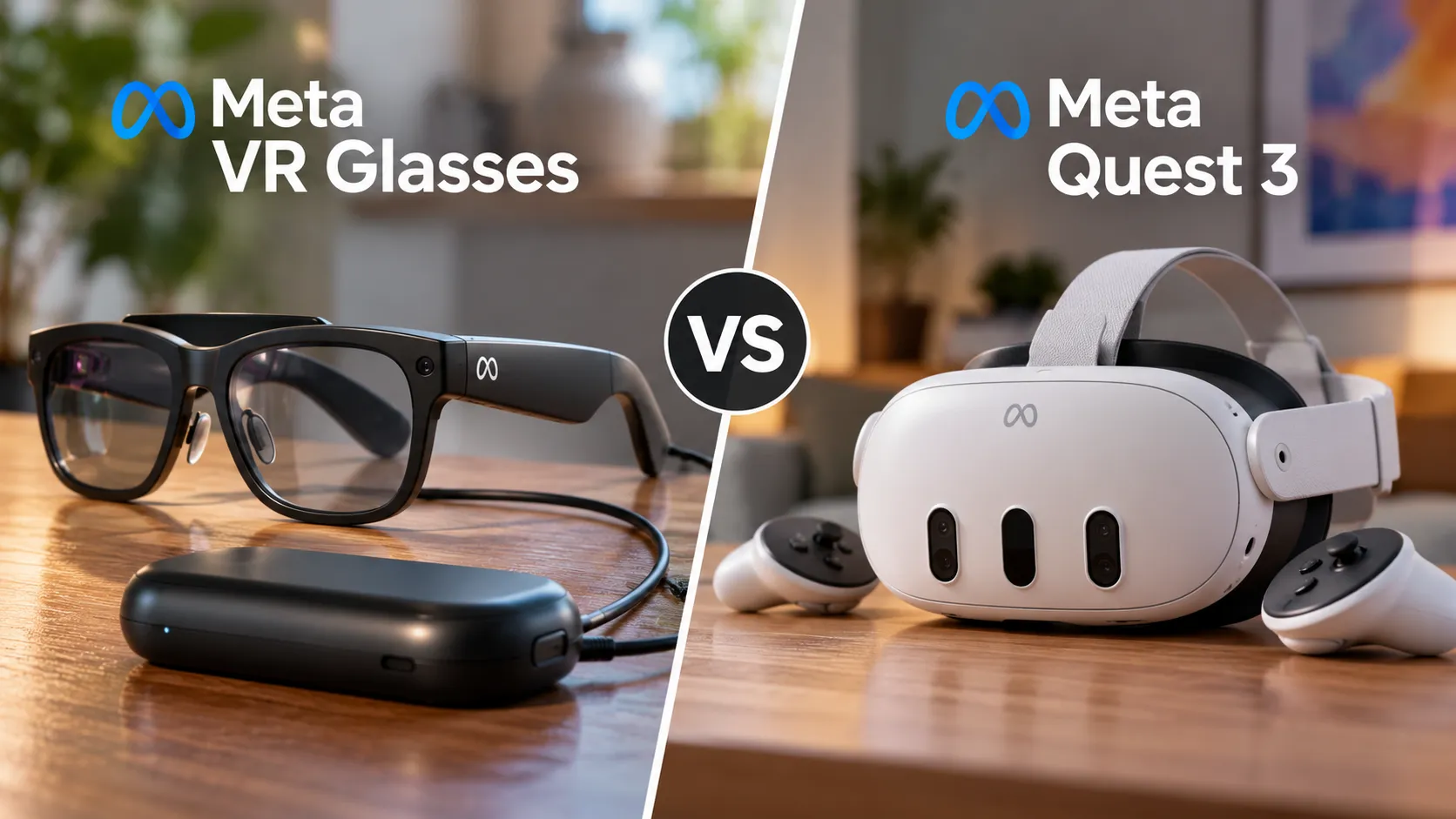
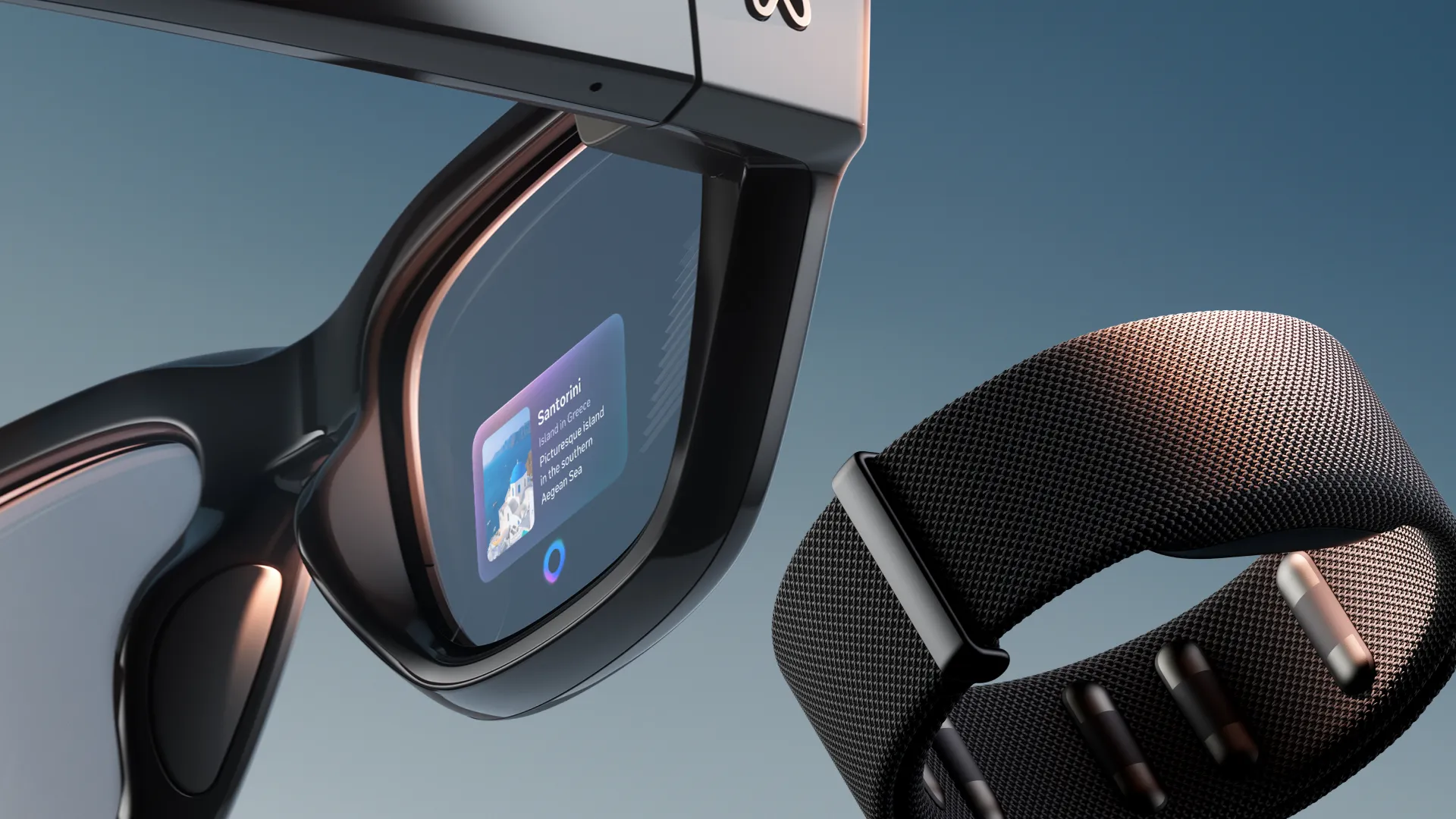
Meta didn't announce a Quest 4 at Meta Connect this week. Instead, it unveiled something that barely resembles a conventional VR headset: Meta VR Glasses, a roughly 100-gram pair of glasses tethered to a pocket-sized compute puck.
That architecture sets up a very different Meta VR Glasses vs Meta Quest 3 comparison. Meta VR Glasses move the processor, battery, and storage off your face and into the puck, while Quest 3 keeps its hardware inside one wireless headset.
Meta VR Glasses will cost $1,299.99 when they launch in spring 2027. Meta currently lists the 512GB Quest 3 at $599.99, making the new glasses about $700 more expensive.
The premium buys a much lighter device, sharper micro-OLED displays, eye tracking, and a new eyes-and-hands interface. Quest 3 remains fully wireless, includes controllers, offers a substantially wider field of view, and costs less than half as much.
Meta VR Glasses vs Meta Quest 3 design and weight
The biggest difference is architectural.
Quest 3 is an all-in-one headset. Its displays, Snapdragon XR2 Gen 2 processor, battery, storage, and sensors are all worn on the head.
Meta VR Glasses split those components between the glasses and a wired puck. The glasses handle the displays and sensors, while the puck contains the Snapdragon XR2 Gen 3 processor, battery, and storage.
That lets the glasses themselves weigh about 100 grams. Meta says that's roughly five times lighter than Quest 3.
There is no head strap. Meta instead uses folding temple arms, adjustable nose pads, two frame sizes, and magnetic prescription-lens inserts.
The tradeoff is the tether. The compute puck clips to a pocket or bag, so the weight comes off your face without disappearing entirely. Engadget's hands-on testing put the puck at roughly 300 grams.
Quest 3 takes the opposite approach. It is heavier on the face, but once the headset is on, there is no compute pack or cable attached to your body.
That distinction matters for movement. Meta's own developer specifications support both stationary and room-scale experiences on VR Glasses, just as Quest 3 does, so the glasses are not technically limited to seated use. Early reviewers have simply emphasized media and productivity more heavily because those are areas where the lighter design is particularly noticeable.
Meta VR Glasses display vs Quest 3
Display clarity is one of the strongest advantages for Meta VR Glasses.
Meta's official device comparison lists a 2412-by-2288-pixel micro-OLED display for each eye at 37 pixels per degree. Meta markets the complete optical system as its 5K Infinite Display.
Quest 3 uses LCD panels at 2064 by 2208 pixels per eye and 25 PPD.
That makes Meta VR Glasses substantially sharper on paper, particularly for text, virtual monitors, movies, and other content where fine detail matters.
The glasses also add eye tracking, Dolby Vision, HDR10 and HLG support, while Dolby Atmos audio is built into the frames.
Quest 3 gives up some sharpness for a much larger viewing area.
Meta lists Meta VR Glasses at a nominal 70-degree horizontal and 66-degree vertical field of view. Quest 3 reaches 110 degrees horizontally and 96 degrees vertically.
That is a 40-degree difference horizontally, considerably larger than some early hands-on estimates suggested.
The narrower view means Meta VR Glasses provide greater pixel density partly by concentrating their display across a smaller visible area. Quest 3 gives users more peripheral immersion.
Both devices support refresh rates up to 120Hz.
Battery life and performance
Meta VR Glasses use Qualcomm's Snapdragon XR2 Gen 3 processor with 12GB of memory. Quest 3 uses the older XR2 Gen 2 with 8GB.
Meta rates the VR Glasses puck for up to three hours of continuous high-resolution media playback and supports 45W fast charging.
That three-hour figure should not be treated as a universal battery-life rating. Meta specifically ties it to media playback, and battery life during demanding VR games, mixed reality, or productivity workloads could differ.
Meta lists Quest 3 at around two hours of battery life.
Both devices support Meta Quest Link over a cable or Air Link for PC VR.
The glasses add a feature Quest 3 lacks: DisplayPort input through the puck. Meta says that lets VR Glasses serve as an external display for a Mac, Windows PC, or console.
Hands, eyes, and controllers
Meta VR Glasses are designed around eye and hand tracking instead of physical controllers.
Users can look at an interface element and pinch to select it, while hand gestures handle actions such as scrolling and navigation. Cameras in the glasses track the hands, including when they're lower in the user's field of view.
Controllers remain optional.
Meta VR Glasses support Meta Quest Touch Plus controllers, but they are sold separately rather than included in the standard package. Existing compatible Touch Plus controllers can also be paired with the glasses.
Quest 3 includes a pair of Touch Plus controllers in the box and also supports hand tracking.
That creates a meaningful difference for gaming. Meta says more than 75 games will support controller-free hand input when VR Glasses launch, but the wider Quest library was largely designed around controllers.
Existing Quest apps are not automatically guaranteed to work perfectly on VR Glasses. Meta says the devices share Horizon OS, the Store, and the same broader development platform, but compatibility still depends on the app.
For example, Meta's developer documentation says apps containing only 32-bit native libraries cannot run on VR Glasses. Controller-required games can be installed, but they cannot be played until compatible controllers are connected.
That is broader compatibility than starting a new platform from scratch, but it is not the same as saying every existing Quest app works unchanged.
Meta VR Glasses vs Quest 3 price and ecosystem
Meta VR Glasses will launch in spring 2027 for $1,299.99.
Meta currently lists Quest 3 starting at $599.99 for the 512GB model, so the VR Glasses carry a $700 premium.
Both products use Meta Horizon OS and the Meta Horizon Store, giving the new device access to the existing Quest software ecosystem where individual apps meet its compatibility requirements.
Meta is also building experiences specifically around the new hardware.
The company says more than 75 games will support hand-only play at launch. It is working with Disney+, Prime Video, YouTube, DirecTV, AMC+, Crunchyroll, Plex, ESPN, Peacock, HBO Max, Paramount+, and other services on its media lineup.
Meta VR Glasses will also be the first IMAX Enhanced-certified VR device. Meta says thousands of media titles will be available internationally by launch, alongside more than 100 immersive live sporting events each year.
For productivity, the glasses support multiple virtual displays and can connect to a Mac or Windows PC. Meta also demonstrated a feature that turns a flat surface into a virtual keyboard and touchpad.
Those additions push the glasses further toward personal entertainment and spatial computing, while Quest 3 remains a more traditional all-in-one VR and mixed reality headset.
Which should you buy?
Quest 3 remains the more practical choice for someone buying a Meta headset primarily for VR gaming today.
It costs $599.99, includes Touch Plus controllers, has a much wider field of view, and keeps everything inside a wireless headset. Its software library is already established, and there is no puck or optical cable to carry.
Meta VR Glasses make a different trade.
They put far less weight on the face, increase display density from 25 PPD to 37 PPD, add eye tracking, upgrade to micro-OLED, and move to a newer XR2 Gen 3 processor. They also offer media and productivity features that Meta is positioning as major parts of the experience.
In exchange, the field of view falls from 110 degrees on Quest 3 to 70 degrees, controllers cost extra, and the compute puck remains physically tethered to the glasses.
The $1,299.99 price also makes this a different class of purchase from Quest 3.
For now, the comparison is still partly theoretical. Meta VR Glasses do not ship until spring 2027, and current impressions come from controlled demonstrations and preproduction hardware.
Quest 3 is the known quantity. Meta VR Glasses are the more ambitious option, built around the idea that moving most of the hardware off your face is worth carrying a puck and paying considerably more for sharper displays and lighter eyewear.




Comments
Be the first, drop a comment!