


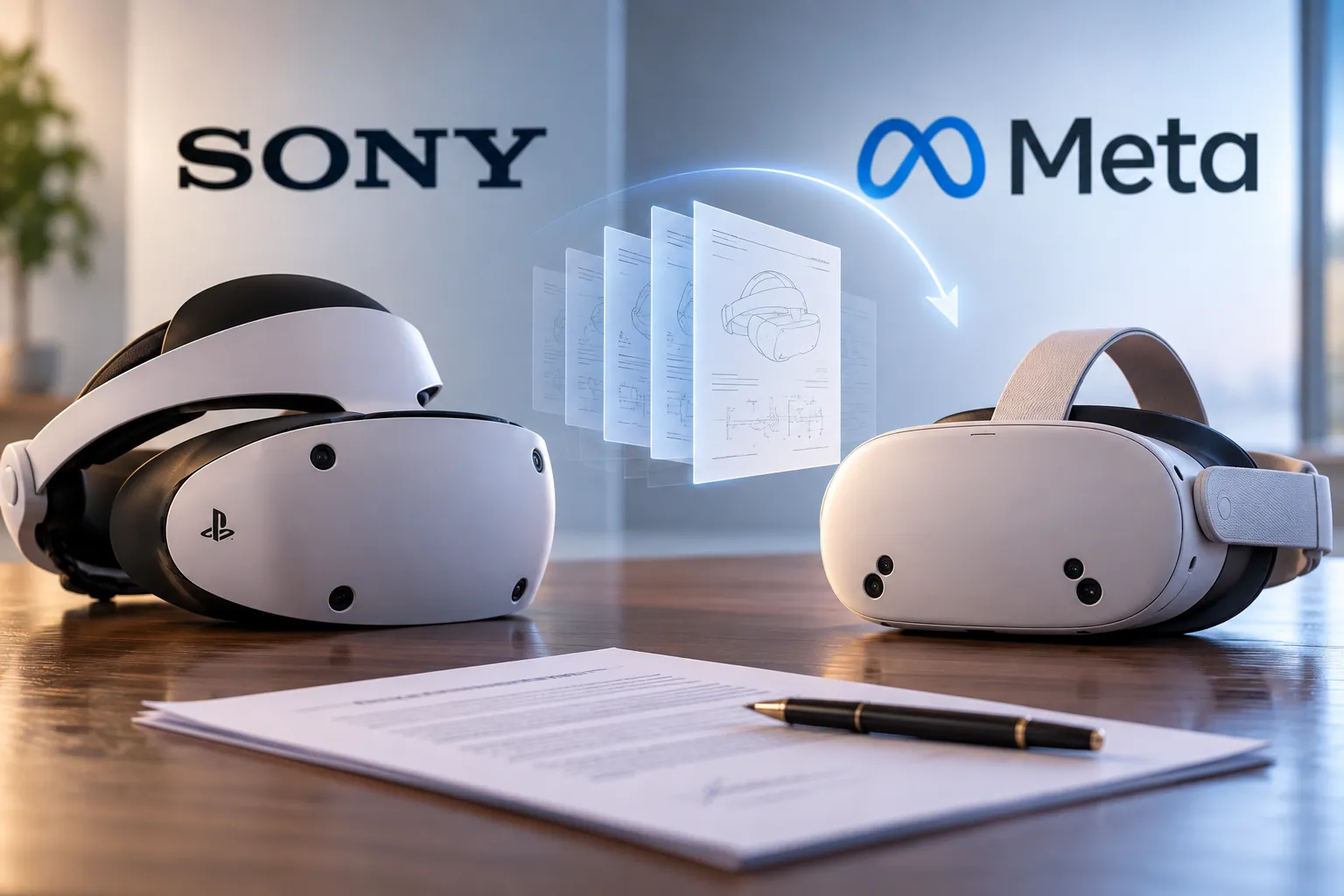
When word broke that Sony had sold XR patents to Meta, the easy read was that Sony was quietly abandoning its VR ambitions and that Meta had just widened the gap with Apple Vision Pro in gaming. The filings themselves tell a narrower story, and it isn't about Apple at all.
An agreement effective Dec. 17, 2025, lists 419 patent and application rows worldwide in a transfer between Sony Group Corporation and Meta Platforms, including 180 US properties, according to VR.org and ZDNet Korea. As of VR.org's Oct. 7 review, five assignments covering 43 US properties had been recorded in the public USPTO database.
That gap between 419 scheduled rows and the smaller number of US properties recorded so far isn't a sign that the rest of the deal stalled. Under US patent law, an assignment can be valid between the companies without being recorded; recording mainly protects the buyer against certain later purchasers or mortgagees without notice. The paperwork can therefore appear on its own schedule, separate from when the underlying agreement took effect.
Road to VR and ZDNet Korea each read the scale of the transfer as a sign that Sony may be scaling back its XR hardware ambitions. That's an interpretation, not something Sony has announced. Nothing in the public record ties the sale to Apple's position in VR gaming, either. What the patent schedule establishes, what it leaves open about Sony's console VR plans, and what it means for Meta's broader XR position are separate questions.
What the Sony Meta XR patent transfer confirms
Schedule 1 of the agreement contains 419 rows, including 180 US, 96 Japanese, 81 Chinese, and 27 German patents or applications. The remaining properties are spread across several other jurisdictions. The portfolio covers technology including XR-specific processing, head-mounted displays, and XR glasses, with filings dating from 2010 to 2022.
The agreement is effective as of Dec. 17, 2025, but the signatures came later. VR.org reports that Jeremiah Chan, Meta's director and associate general counsel for patents, signed April 29, 2026, while Asashi Shimodaira of Sony's Intellectual Property and Standards Division signed April 30.
USPTO recording came later still. Five assignments were recorded between June 30 and Sept. 18, covering 43 properties in total. Those are five recordations, not five patents.
The headline count of 43 US properties also needs a caveat. ZDNet Korea counted 43 properties recorded to Meta, but VR.org's row-by-row review found complications in the filings. Two entries from the July 29 recordation appear to use application numbers belonging to unrelated patents because Sony patent numbers were entered in the wrong field. Four other recorded properties are related filings that don't appear as separate rows on Schedule 1.
After accounting for those issues, VR.org found that 37 of the 180 US rows on Schedule 1 showed Meta as the owner of record as of Oct. 7. The 43 figure describes the properties appearing across the five USPTO recordations, while 37 is the number that directly corresponds to rows on the agreement's US schedule.
These aren't all near-expired patents Sony was simply clearing out. Expiration dates for the US properties on the schedule run from September 2028 through August 2041. Of the 180 US rows, 122 have expiration dates in 2036 or later, while only five expire before the end of 2029.
Neither Sony nor Meta has publicly disclosed the price or explained the business rationale for the transaction. What's confirmed is narrower: Meta acquired a large, long-lived portfolio of XR-related patent rights from Sony Group. That's a significant transaction, but it isn't, by itself, a roadmap of what either company intends to build or discontinue.
Does this mean Sony is pulling back from XR hardware?
Every one of the five USPTO recordations reviewed by VR.org names Sony Group Corporation, the parent company, as the seller. None names Sony Interactive Entertainment, the subsidiary behind PlayStation and PlayStation VR2.
PS VR2 launched in February 2023 and remains Sony's current PlayStation VR headset. Sony Group also has a history of XR and head-mounted-display development outside the PlayStation business, so the identity of the seller matters when interpreting the transaction.
Road to VR and ZDNet Korea both read the size of the 419-row worldwide transfer as a possible signal that Sony is scaling back its XR hardware ambitions. That's a reasonable inference from a transaction of this size, but it remains an inference. Sony hasn't announced that it's leaving XR or discontinuing PlayStation VR.
The fact that Sony Interactive Entertainment isn't named in these assignments also doesn't prove that PS VR2 technology or Sony's PlayStation VR plans are unaffected. Patent ownership inside a corporate group doesn't necessarily map neatly onto the subsidiary that commercializes a product.
The filings therefore support a narrower conclusion: Sony Group transferred a substantial XR patent portfolio to Meta, while the consequences for Sony's future hardware plans remain unknown.
Meta, meanwhile, continues investing heavily in XR hardware and technology. Acquiring a large portfolio of Sony XR patents adds to that position, but the filings don't reveal what Meta plans to do with individual patents.
What it means for Apple Vision Pro gaming competition
The patent sale doesn't establish that Meta acquired technology Apple needs for Vision Pro gaming or that Apple lost access to technology it previously depended on. Nothing in Schedule 1 identifies Apple as a party to the transaction.
More importantly, the Apple gaming situation has changed substantially since some of the reporting cited in the original analysis.
Apple Vision Pro now officially supports Sony's PlayStation VR2 Sense controllers as spatial accessories with visionOS 26. The controllers provide six-degrees-of-freedom tracking, physical buttons, triggers, joysticks, finger detection, and haptic feedback for compatible Vision Pro experiences.
Apple also sells a PlayStation VR2 Sense Controller and Charging Station package directly for Vision Pro. That means the earlier controller gap is no longer accurately described as Vision Pro owners relying only on standard Bluetooth gamepads, unofficial workarounds, or the prospect of Apple eventually developing its own tracked controller.
The history is still relevant. WIRED reported in March 2025 on Apple's exploration of handheld input devices and on earlier efforts to bring Sony's controllers to Vision Pro. But what was then a potential solution has since become a shipping feature.
That also changes how the Sony-Meta patent transaction should be interpreted. None of the five assignments reviewed by VR.org names Sony Interactive Entertainment as the seller, and nothing in the public filings establishes that Meta acquired the PS VR2 Sense controller technology now supported by Vision Pro.
Apple's remaining challenge is therefore less about the complete absence of tracked controllers and more about software support. PS VR2 Sense controllers can now provide the physical input and haptics that hand tracking alone cannot, but individual Vision Pro apps and games still have to support spatial accessories.
Apple has continued expanding that support at the platform level. visionOS 26 added PS VR2 Sense compatibility, and Apple's developer tools expose spatial-controller tracking to games and immersive apps. That gives developers a supported route to controller-based Vision Pro experiences rather than relying on unofficial hardware workarounds.
The Sony-Meta patent sale may strengthen Meta's long-term XR intellectual-property position. It doesn't explain Vision Pro's gaming challenges, and the public record doesn't show that Meta acquired technology that prevents Apple and Sony from continuing to support PS VR2 Sense controllers on Vision Pro.
What to watch next
What's established: Meta acquired a substantial portfolio of XR-related patents and applications from Sony Group under an agreement covering 419 rows worldwide, including 180 in the US. Many of those US properties have years of potential life remaining.
What's still open: why Sony sold the portfolio, how Meta plans to use it, whether the transaction reflects a broader retreat by Sony from XR hardware, and what it means, if anything, for the future of PlayStation VR. Neither company has publicly answered those questions.
The distinction between Sony Group and Sony Interactive Entertainment remains worth watching, but no single future patent filing would prove that PlayStation is abandoning VR. Product announcements, software investment, hardware availability, and Sony's own statements would provide stronger evidence.
Apple's side is clearer than it was when the earlier controller reports appeared. Vision Pro now officially supports PS VR2 Sense controllers, complete with spatial tracking and haptic feedback. The next question is whether enough developers build games and immersive experiences around that support to make it meaningful.
Patent filings provide a useful paper trail for ownership. They're a poor substitute for watching what Sony, Meta, and Apple actually ship.


Comments
Be the first, drop a comment!