


VR modder throws virtual models at 3D printer: fact-checked
The claim reads like a highlight-reel moment: a VR modder throws virtual models at 3D printer, and the print supposedly starts before the object even finishes its arc. No video, account, or creator statement accompanies it, so it's treated here as unverified, not as a confirmed event with a citation waiting to be found.
Three things need to stay separate in what follows. Software exists that documents parts of a chain like this. Published research has tested VR in an adjacent fabrication task. And no source found during this review ties an actual throwing gesture to a completed print job. This isn't a general explainer on VR meeting 3D printing; it's an attempt to sort out what's demonstrated from what's merely plausible.
Part of that chain already exists as documented software. An open-source project called Polyslice, copyrighted to developer Jacob Philpott and described in its own documentation as an AI-powered slicer for the three.js ecosystem, can convert a three.js mesh directly into G-code and send it to a connected printer over the Web Serial API or Node's serialport, a workflow the project says eliminates the need for intermediary file formats and third-party slicing software (jgphilpott/polyslice). The project's code was updated as recently as March 2026, so it's actively maintained, not an abandoned proof of concept.
Separately, researchers at Paderborn University published work in 2024 testing VR for monitoring an industrial metal-fabrication process, real fabrication work that looks nothing like a handheld throw-to-print gesture (Paderborn University). What follows traces where a search for a primary source came up empty, what a system built to send 3D models from VR to a 3D printer would actually need to handle, and what that research does and doesn't support.
Tracing the claim: what a search actually found
A review of the public repositories, project pages, and demonstration videos available when this article was reported, covering GitHub, Nexus Mods, and YouTube for terms tied to VR throwing gestures and 3D printing, found no demonstration video, no code repository linking a VR throwing gesture to a slicer or printer API, and no direct statement from anyone credited with building such a system. That describes what this search didn't find, not proof that nothing like it exists anywhere.
The closest material found: a Synthesis patcher built for the Skyrim mod More Interactive Objects - Throwing Things VR Port, which adds destruction to potions, poisons, and other items listed in a configuration file. It was created in October 2024, with its most recent push last summer (Domek97/ThrowingStuffVRPatcher). There's also a 2023 prototype VR combat game built around catching and throwing incoming attacks using natural arm movement, no buttons required (graroe/Throw-Ballistic-VR).
Neither project's cited repository page references 3D printing in any form. Both establish that throwing is a familiar, well-worn VR interaction pattern in games and mods. Neither establishes that this specific claim happened.
What a VR 3D printing workflow would need to do
A three.js mesh isn't necessarily a print-ready object. As a matter of general 3D-printing background, not something the sources reviewed here document directly, a mesh built for real-time rendering doesn't automatically form a closed, watertight "manifold" shell the way a printable model needs to. Turning any model into an actual print means selecting it, validating its geometry, orienting and scaling it, slicing it with the right settings, sending it to a printer, and confirming the job started: a sequence of distinct steps, not one continuous motion.
Polyslice covers part of that chain. It generates G-code directly from a three.js mesh and can transmit it to a printer over the Web Serial API or serialport, and it ships with 44 built-in printer profiles and 35 filament profiles (jgphilpott/polyslice). That's a documented browser or Node.js path from mesh to physical printer, not evidence of a wireless or headset-only setup. The documentation reviewed doesn't describe how those profiles would get matched to an arbitrary thrown object rather than one a user selects and configures on purpose.
Where a thrown model could fail
Several points in that sequence are open engineering questions, not failures demonstrated in any source reviewed for this piece. A model might not be watertight, and nothing in the documentation reviewed describes automatic repair for that case. A throwing gesture doesn't inherently produce a printable orientation or a sensible real-world scale, and nothing reviewed shows that being corrected automatically.
Printer and filament profiles exist for specific hardware, but no source shows them being matched automatically to whatever geometry was just thrown. A ballistic arm motion, the same kind of gesture built into throwing-based VR games like Throw-Ballistic-VR, also raises an unresolved question about accidental activation that the documentation reviewed doesn't address with any confirmation step. Nobody wants a stray gesture queuing up an hour of filament by accident.
A claim like this needs to clear a specific bar before it counts as verified, one used throughout this review rather than an outside industry standard: a visible throwing gesture, an identifiable model handoff, visible slicing output, a connected printer accepting the job, and ideally footage of a completed print. A clip of someone throwing an object in a headset, on its own, shows none of that.
What the research actually tested
None of this is evidence for or against the throwing claim. It's background on how VR is already being used in fabrication research, worth treating on its own terms rather than folded into an undifferentiated "VR plus printing" category.
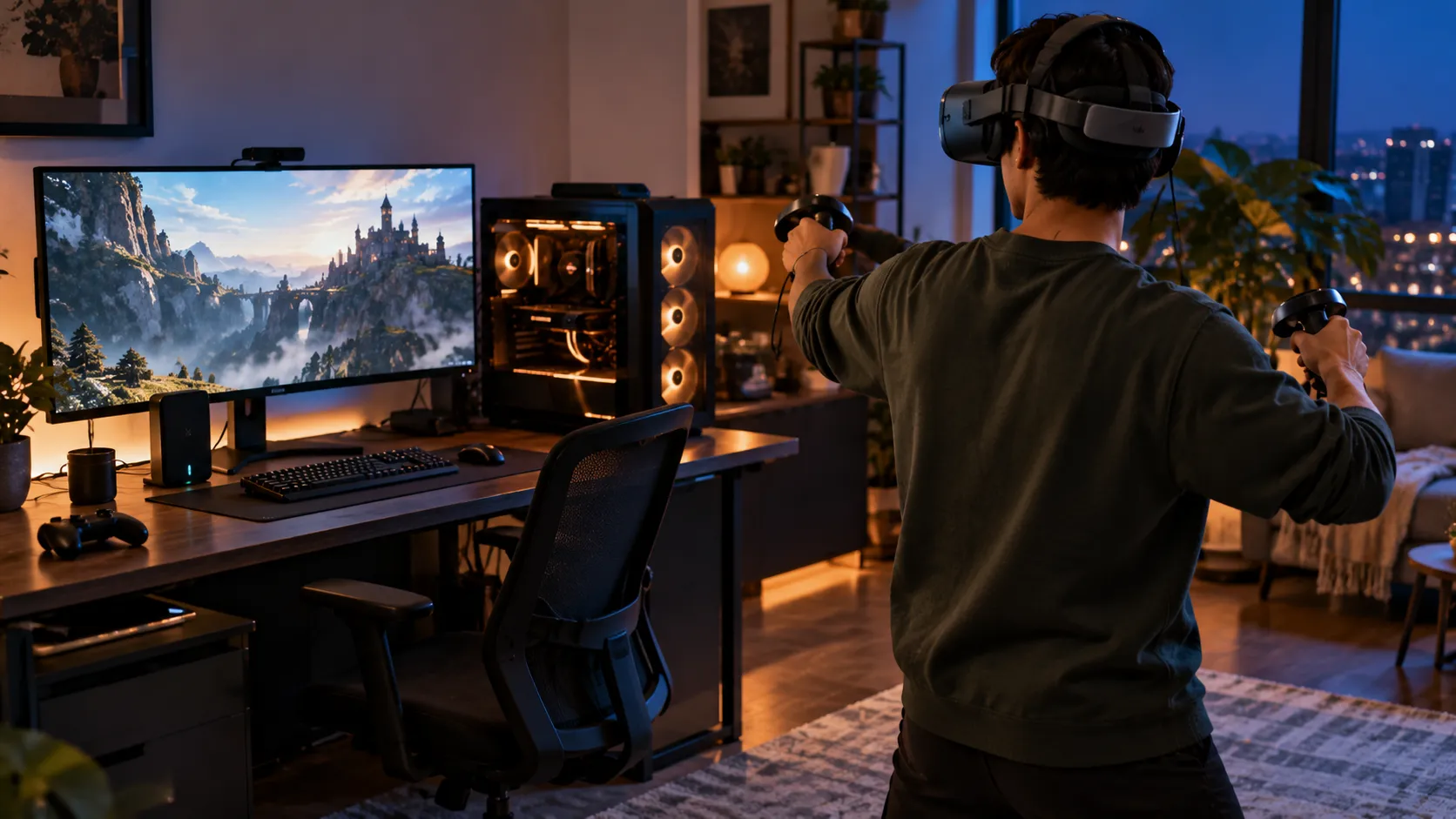
Researchers at Paderborn University built a VR system for supervising laser metal deposition with wire, an industrial metal-fabrication process distinct from desktop FDM printing. Their pipeline overlays measurement data onto a digital shadow of the production site, viewable on static and handheld virtual displays, and lets a supervisor change scale and elevation to inspect the process from different vantage points (Paderborn University). The authors report that the system generated low task load and cybersickness in an exploratory study of 22 participants, and they describe it as "a first promising step" rather than a finished product (Paderborn University).
That study involves a person actively supervising an established process, not an unreviewed gesture triggering a print job on its own. Supervising a process someone else already set in motion is a different technical problem than taking an arbitrary virtual object and deciding, automatically, that it's safe to build.
What would change the verdict
The claim remains unverified. Software exists that documents parts of a plausible chain (jgphilpott/polyslice); research exists testing VR in an adjacent fabrication task (Paderborn University). Nothing found during this review ties those pieces into an actual throw-triggered print job.
That would change with a primary source: a firsthand account or footage showing a throwing gesture, an identifiable model, visible slicing, a printer accepting the job, and a completed print. Until then, browser-native slicing and direct printer communication are real and independently documented, and VR-based supervision of fabrication processes is a live, if early, area of research. Whether anyone has actually wired a throwing gesture into that chain stays a separate, open question, and one worth checking again the next time a clip like this makes the rounds.




Comments
Be the first, drop a comment!