


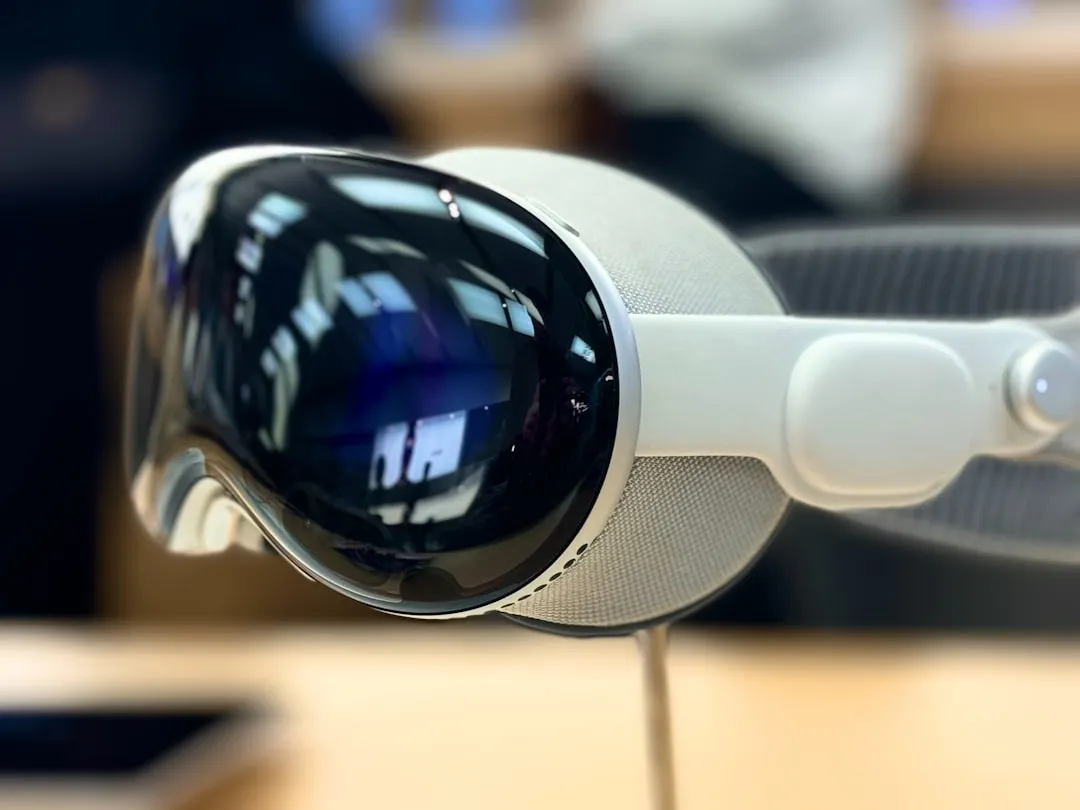
How visionOS 26 Fixes Apple Vision Pro Spatial Audio Performance
Picture three windows arranged across your Vision Pro environment: a video player to the left, a messaging app dead center, a game to the right. The visuals sit exactly where you placed them. The Apple Vision Pro spatial audio performance, until visionOS 26, did not. Every ping, every explosion, every line of dialogue routed from a single point wherever the app's first window happened to open. That mismatch between where something looked and where it sounded was the kind of flaw users felt before they could name it.
Apple has corrected this directly with the new Spatial Audio Experience API, announced at WWDC 2025. Under the old model, every sound played through AudioToolbox or AVFoundation, the two frameworks covering most audio playback on Apple platforms, spatialized from the app's first window regardless of where other windows or volumes were placed. The new API lets each sound originate from its own window or volume and move between scenes without interruption. Developer testing is available now through the Apple Developer Program, per Apple's visionOS 26 availability announcement.
The platform model that changed: one anchor vs. many
The visionOS audio architecture before this update had a single-anchor problem. No matter how many windows or volumes an app placed in a user's physical space, all audio routed from one point: the app's first window. Apple's WWDC 2025 developer session confirmed this was the behavior across both AudioToolbox and AVFoundation, the frameworks that cover most of the audio playback scenarios developers actually build against.
Why did this happen? The single-anchor model reflects how visionOS initially inherited audio spatialization logic from frameworks built before multi-window spatial environments were the norm. When a visionOS app launched, the system needed a spatial reference point for audio; it defaulted to the first window as that anchor. The architecture worked cleanly for single-window apps, and for the earliest generation of Vision Pro software, most apps were exactly that. As Apple pushed harder toward multiwindow productivity use cases, the inherited limitation became more visible.
The Spatial Audio Experience API removes that constraint. Each sound source can now be assigned to its own window or volume, so audio origin tracks visual placement. Apple also specified that sounds can move between scenes without a jarring positional cut, per the same WWDC session.
To be precise about what this is: a platform-model change. Not a hardware upgrade, not a modification to underlying rendering pipelines. Apple hasn't published details on how the spatialization engine was modified internally, whether latency or processing load changed, or how many simultaneous sources the system supports. What the evidence establishes is the behavioral shift: audio can now come from where things are, rather than where the first window was placed.
Apple Vision Pro spatial audio performance in multiwindow apps and games
The improvement is most obvious in the scenarios that exposed the old flaw most sharply.
Take a multiwindow productivity setup. A user might have a video call in one window, a document editor in another, and a notification panel floating nearby. Under the old model, all three routed audio from a single spatial origin. With per-window spatialization, the voice from a FaceTime call comes from the window containing that call. A notification sound comes from the direction of the notification. The audio layout matches the visual layout which is what spatial computing is supposed to feel like. The old behavior worked against it.
Games benefit similarly, and the gains are arguably more dramatic. A game distributing sound sources across a mixed reality environment ambient audio, character dialogue, UI feedback previously collapsed all of that to one anchor point. Per-volume spatialization means a sound can track an object moving through the space, or distinguish between a UI element on the left and an in-world object on the right. That's not a subtle refinement; it's the difference between a game that feels grounded and one that feels slightly off in a way players can't articulate.
Scene transitions gain a specific capability worth noting. Sounds can now move between scenes without cuts, which Apple demonstrated explicitly at WWDC25 as a deliberate design goal. For narrative apps, games with world changes, or any experience that moves a user between spatial environments, the continuity of audio during a scene shift is a detail that separates polished work from rough work.
Shared-space experiences multiple Vision Pro users in the same room, a scenario Apple has been expanding in visionOS 26 also benefit. When two users interact with the same spatial environment, audio that originates from the correct visual position is less likely to create spatial confusion for either person. The old single-anchor model would have been particularly disorienting in that context.
What this Apple Vision Pro audio upgrade does not change
This is a good moment to draw the boundary clearly, because "spatial audio upgrade" can imply more than what's actually shipping.
The Spatial Audio Experience API does not improve the underlying fidelity of audio rendering. Sound quality, reverb simulation, and the precision of the head-tracking-based spatialization engine are unchanged by this API. Apple spatial audio on Vision Pro was already technically capable of placing sounds accurately in 3D space; the problem was that the placement coordinates were always being supplied from the wrong source, the first window, rather than from each individual window or volume.
The upgrade is also not automatic. Existing apps continue to spatialize from the first window until developers adopt the new framework. Users running older app versions won't see any change. The improvement only appears in apps that ship updates implementing the API, and it will be most perceptible in apps with high window counts, moving elements, or multiple simultaneous sound sources.
There are no published before-and-after benchmarks measuring localization accuracy under the new model. No independent tests comparing the old single-anchor behavior to per-window spatialization have been released. What's established is the architectural fix, not a measured outcome.
What developers need to do
Adopting the Spatial Audio Experience API requires explicit implementation work. Developers need to assign spatial origins to individual windows or volumes rather than relying on the system default. For apps that currently play audio through AudioToolbox or AVFoundation with no spatial configuration, the migration path means identifying each sound source and mapping it to the appropriate window or volume.
For games, the calculation is likely worth it even for moderate complexity. Any game distributing sound across spatial volumes and most mixed reality games do will produce a more coherent experience after adoption. The API also handles seamless scene transitions at the framework level, which removes code complexity developers would otherwise have to manage manually.
For productivity apps, the priority is lower but still meaningful for multiwindow layouts. An app with two or three consistently placed windows may produce subtle but noticeable audio improvement after adoption. An app with a single main window probably won't see any user-perceptible change.
Who notices first: power users, gamers, and shared spaces
The users most likely to notice the difference before broad adoption settles in are those running complex multiwindow setups and anyone using Vision Pro primarily for gaming.
Power users who have invested in building out spatial workspaces multiple windows arranged deliberately around their environment have been the most likely to feel the old flaw acutely, even if they couldn't name it. A FaceTime call positioned to the right that sounded like it was coming from straight ahead was a persistent low-grade inconsistency. That's exactly what per-window spatialization corrects.
Gamers come second, particularly those playing titles that make heavy use of positional audio cues. Games that rely on directional sound for gameplay feedback approaching enemies, ambient spatial context, UI alerts will be most transformed by the change. The gap between visual and audio positioning in those contexts was a meaningful fidelity issue, not just an aesthetic one.
Shared-space users are the third group. Experiences built around multiple Vision Pro users in the same room depend on spatial coherence more than solo experiences do. When audio tracks to the correct visual location in a shared environment, the coordination between users becomes more natural.
Why placement accuracy may matter more than fidelity
The intuitive argument wrong direction is disorienting has structural support in the research, though the strongest available evidence concerns spatial video rather than audio. That caveat is worth naming directly.
A 2025 Cardiff University study, "Perceptual Quality Assessment of Spatial Videos on Apple Vision Pro," evaluated how participants perceived spatial versus 2D video on the device, testing across three quality levels with 27 participants. Raw video quality ratings were nearly identical between formats; ANOVA found no statistically significant difference (p = 0.479). Spatial content scored dramatically higher on depth perception and overall quality, with both differences reaching p < 0.0001, according to the Cardiff paper. A linear model combining perceived video quality and depth perception explained 97.4% of the variance in overall quality scores, with depth perception carrying slightly more predictive weight than raw image quality.
The pattern maps onto the audio change Apple is making, even though the Cardiff study didn't test audio. In immersive environments, knowing where something is matters as much as how sharp or clean it looks or sounds. A Vision Pro experience where audio comes from the correct location may feel more convincing than one with technically superior audio arriving from the wrong direction.
What the Cardiff data doesn't provide is direct validation of the new API. The study is an analogy, a suggestive one, but an analogy. The case for the audio API rests primarily on the logical coherence of fixing an acknowledged mismatch, and on the fact that the mismatch was real and documented.
What users and developers can expect
The Spatial Audio Experience API is open for developer testing now through the Apple Developer Program, per Apple's visionOS 26 announcement. End users won't find it in settings. They'll encounter it, when developers ship updates, as environments that feel more coherent audio and visuals occupying the same space rather than working at cross-purposes.
The Cardiff study's clearest implication is that the gains here, when they arrive, may be larger than the change looks on paper. Depth perception's slight edge over raw video quality in predicting overall experience, captured in a linear model explaining 97.4% of quality score variance, per the Cardiff paper, suggests spatial correctness carries more perceptual weight than its technical description implies. This visionOS 26 audio upgrade isn't louder sound or cleaner sound. It's sound that comes from the right place.
Two things will determine how much this matters in practice: how quickly developers adopt the API, and whether the improvement is legible enough in everyday use that users register it as a genuine change rather than a vague sense that something is better. Independent localization benchmarks comparing old and new behavior would settle the question more definitively. Until those exist, the evidence points consistently in one direction and the flaw being fixed was real.



Comments
Be the first, drop a comment!