


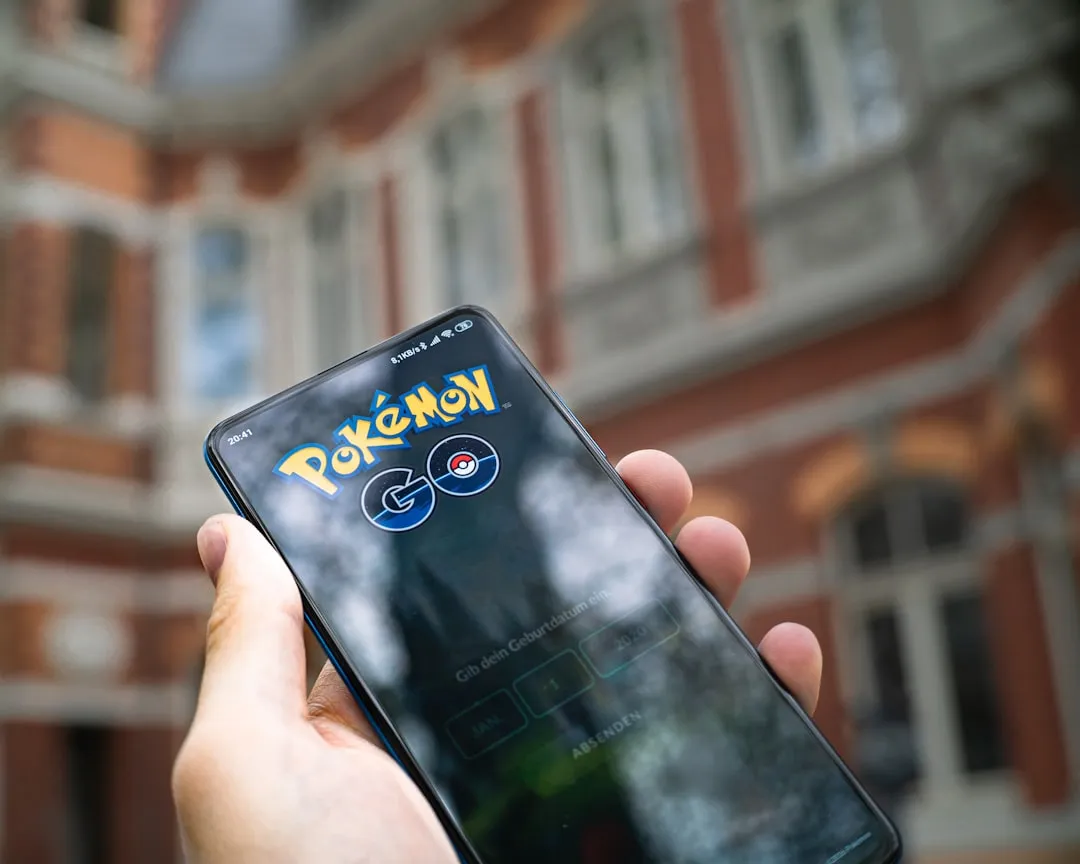
Pokemon Go 10th Anniversary Event Delivers on Its Original Promise
The original Pokémon Go reveal trailer, released in 2015, ended with a scene that looked more like a fantasy than a product roadmap: hundreds of players flooding Times Square together to bring down a Mewtwo. It was the central premise rendered as spectacle. When the game launched in 2016, the game was nowhere near capable of supporting that kind of synchronized public event.
This week, nearly scene for scene, it happened. The Pokemon Go 10th anniversary event brought almost 2,000 players into Times Square as billboard takeovers revealed a Mega Evolving Mewtwo, and players battled in unison on their phones. Scopely VP of product Michael Steranka described it as fulfilling a vision that "was just a pipe dream" a decade ago (The Verge, this week). The game has surpassed 800 million cumulative downloads and generated $1 billion in revenue in 2025 alone, according to Scopely figures released alongside the anniversary (The Verge, this week).
Times Square is the proof point for a claim the game has been building toward for a decade. Pokémon Go's actual product, as this piece will argue, was never AR overlays or mobile mechanics. It was coordinated in-person play at scale. Delivering that required building systems the original launch didn't have, surviving a catastrophic early failure, and making a deliberate organizational bet that most companies in the same position would not have made.
The promise was about crowds, not cameras
Most viewers watching the 2015 trailer didn't fixate on how the AR overlay worked. The compelling part was the crowd: strangers converging on a shared physical location to do something together. That's not a rendering challenge. It's a coordination problem, and coordination at scale is considerably harder to solve.
The original game had no infrastructure for large-scale synchronized local play. Raid battles didn't exist at launch, arriving years later as a feature designed for small groups finding each other organically near a gym, not for hundreds of players gathered at a designated location simultaneously. A sociological analysis of the game's first decade describes Pokémon Go as having broken the circle of screen-bound gaming by routing play into streets, parks, places of worship, and public squares worldwide (Zenodo, earlier this year). But the shift the trailer actually promised required more than a location layer on top of a mobile game. It required the operational capacity to make thousands of people show up to the same place and have a reliable, synchronized experience when they got there.
The harder promise was social, not technical. Phone cameras can overlay digital creatures on real environments well enough for casual play; that problem was tractable. A game that reliably turns a patch of real geography into a place where strangers show up and something actually works for all of them simultaneously? That's a different order of difficulty. It explains why it took a decade, and why the decade looked the way it did.
From the Pokemon Go original promise to the Times Square Mewtwo raid
The gap between the 2015 trailer and the 2026 Times Square event is not a story of steady forward progress. There's a specific rupture in the middle that forced a reckoning.
In 2017, Niantic staged its first major live event in Chicago, the template for what would become Go Fest. Thousands of players attended and found a broken experience: network overloads and software failures made the game largely unplayable, and Niantic accepted public responsibility for the collapse (The Verge, this week). Steranka, who had joined Niantic that year to help run the event, said during this week's press briefing that he believed at the time he "should have been fired" an unusual thing to volunteer during an anniversary celebration. What followed was more instructive than the failure itself. Rather than retreating from the live-event format or cycling through internal blame, the team convened an offsite in Seattle. Steranka described the response plainly: "Instead of trying to find someone to blame, everybody came together, and we spun up an offsite in Seattle to learn what went wrong and how to fix things" (The Verge, this week).
From that point on, the company kept betting on live play instead of treating Chicago as a warning to stop. That decision is documented; the specific engineering improvements are not, at least not in available reporting. What the record shows is the outcome: events kept running, their scope kept expanding, and the game kept growing commercially. According to The Verge, doubling down on community-focused in-person events has been central to the game's growth over the years. The specific technical architecture that made Times Square possible remains undetailed in public disclosures; what can be said is that the operational maturity required to run a synchronized 2,000-person raid battle in one of the world's most congested urban environments did not exist in Chicago in 2017, and it demonstrably did in New York in 2026.
That gap, nine years wide, represents the actual product development arc. Not feature updates or graphics improvements, but the accumulated operational knowledge of how to stage collective play at a scale the original game could not have handled.
What the Pokemon Go NYC Go Fest 2026 model actually proves
The 2026 global Go Fest, running this weekend after the Times Square event, is expected to bring millions of players worldwide into public spaces for cooperative Mewtwo encounters and shared challenges, described by The Verge as the game's most ambitious coordinated event yet, though The Verge notes those millions are "probably going to be out and about" rather than guaranteed. That scale, even hedged, illustrates the platform's real competitive advantage. It isn't the AR layer, which other developers can replicate. It's a community and event infrastructure capable of mobilizing enormous numbers of people to show up somewhere together, reliably, and have the experience hold together when they do.
For anyone who doesn't follow Pokémon closely, the useful comparison is this: think of a concert promoter versus a band. The band is the draw, but the promoter's real product is the logistics machine that puts 60,000 people in an arena and ensures the sound works, the crowd flows, and the experience matches the ticket price. Pokémon Go's AR overlay is the band. The event infrastructure is the promoter. And promoters, unlike bands, are very hard to clone quickly.
The revenue figures reflect that. Scopely reported $1 billion in 2025 revenue from Pokémon Go (The Verge, this week). Whether the live-event model is the primary driver of that figure or one contributor among several isn't established in available data. What can be said is that the correlation between sustained investment in in-person events and sustained commercial performance is consistent across the game's run, and that no comparable mobile title has built a comparable event machine.
What this model costs
The same design logic that produced Times Square carries a cost worth naming directly.
The more effectively a game ties play to real locations and player movement, the more that movement data can be exposed or misused. Researchers examining the game's gift postcard system found, in a proof-of-concept study with four active participants, that a player's home and work locations could be inferred to within roughly half a kilometer based on postcard exchange data alone (arXiv, 2023). The sample is too small to generalize, and the study is a preprint. But the mechanism is real and follows directly from what makes coordinated location-based play possible. The same system that gets players into the same square also reveals where some of them spend most of their time. Gift postcards are generated by the PokéStops nearest to wherever a player happens to be; send enough of them to an in-game friend and you've handed that person a readable map of your routine.
The study identified cyber-enabled stalking as the highest-probability risk enabled by this feature, noting that it requires relatively low effort from an offender since it exploits a core gameplay mechanic rather than requiring physical surveillance (arXiv, 2023). Anecdotal reports of such exploitation already exist in the record the researchers surveyed.
This isn't a reason to discount what Times Square achieved. It is, plainly, the honest cost of the model. A game built on knowing where players are and routing them toward each other in physical space will always produce this exposure as a byproduct. That's not a design flaw, exactly; it's a design consequence. And as Scopely scales the platform, particularly with global Go Fest events drawing potentially millions of participants, the responsibility for addressing that consequence scales alongside it.
What the decade actually built
Times Square didn't prove that Pokémon Go became the best augmented reality application in the world. It proved that the game became one of the clearest examples of coordinated real-world social play at mobile scale ever built, which turns out to be a more durable and commercially significant achievement than AR novelty.
Delivering on the original promise required operational maturity that couldn't be shortcutted. It required event infrastructure capable of handling thousands of simultaneous participants without breaking, a community that kept showing up year after year after Chicago, and a team that treated a humiliating early failure as a solvable problem rather than a signal to retreat. Those are organizational achievements, not product features. They accumulate slowly, and the record suggests they don't transfer easily.
Scopely acquired Niantic's games business last year and now stewards both the platform and its accumulated operational knowledge (The Verge, this week). With new mainline Pokémon titles expected next year, the question isn't whether the game can sustain another decade on current mechanics. The question is whether Scopely can preserve the organizational posture, specifically the willingness to treat live-event failures as engineering problems rather than PR problems, that turned Chicago into Times Square. That's harder to acquire than a game catalog, and it's the part of this platform that can't be replicated by standing up a competitor with better AR filters.
The 2015 trailer made a crowd in Times Square look like fiction. It took until this week to prove it wasn't.



Comments
Be the first, drop a comment!