


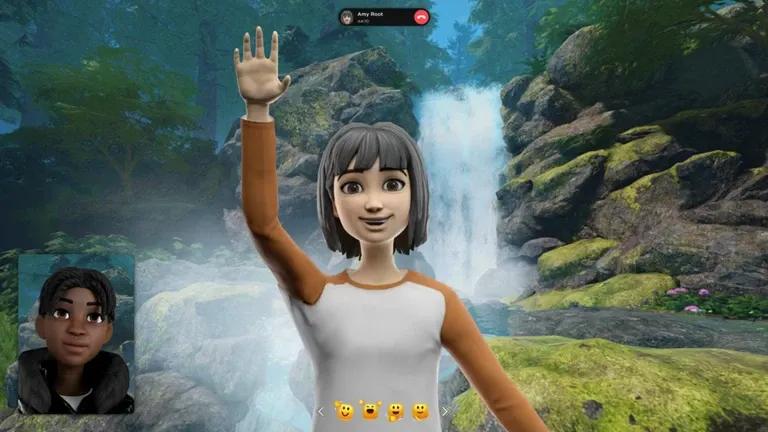
Roblox Connect, the platform's avatar-based video calling service, went offline today. Spokesperson Angela Allison confirmed the full shutdown: both the consumer-facing feature and the developer-facing API layer were discontinued simultaneously on July 15. For developers who built calling flows around Connect's APIs, the cutover is immediate and breaking. Roblox says users 13 and older were already gravitating elsewhere, predominantly to Party Voice, the platform's voice-only private calling feature before the plug was pulled.
The shutdown ends a roughly two-and-a-half-year experiment. Connect launched in November 2023. It never got a public second act, and today it got a quiet exit.
What Roblox Connect actually was
Connect was an ambitious product by the platform's standards. Users appeared as their customized Roblox avatars, which mirrored real-world camera movements in real time, and could explore a shared virtual environment together during a call. Real-time avatar rendering, movement mapping, shared virtual spaces: the feature sat closer to a lightweight hangout in a social metaverse than anything resembling a standard voice call.
That complexity came with trade-offs. Avatar rendering and movement mapping require more processing overhead than audio-only communication, and a shared virtual environment introduces more variables to monitor. Party Voice operates on a fundamentally different model — voice-only, no visual layer, no shared space and those differences matter for how the platform governs it.
Party Voice requires Roblox to verify a user's age as 13 or older and supports private voice calls for eligible users, including calls with Trusted Friends. A Roblox staffer described it in last month's developer forum announcement as handling "private voice chat in a way that's more capable and better suited to how players use Roblox today." That framing positions Party Voice not as a fallback but as the intended destination the product Roblox actually wants users on.
Connect vs. Party Voice: what Roblox chose and why
The company's stated rationale is user behavior. Users 13 and older "predominantly" use Roblox Party Voice chat for private calls on the platform, according to Allison's statement. That doesn't mean Connect had no users; it means Party Voice was clearly winning.
The two products aren't equivalent replacements in a functional sense. Connect lets users be present together as avatars moving, exploring, existing in a shared visual space. Party Voice is a voice call. The capabilities are different enough that users who genuinely want the Connect experience don't have a like-for-like substitute. Roblox's position, reading between the lines of its statements, is that most users didn't want that experience; they wanted to hear their friends, not navigate a virtual room with them.
There's a reasonable argument that Roblox never gave Connect a fair shot. At least one developer on the forum objected directly to the shutdown, writing that the community had been waiting for Connect and its APIs to get upgrades that would support more simultaneous callers, the kind of upgrade that would have made it practical inside actual game experiences before the shutdown was announced, per the forum thread.
That's one developer's view, not a documented pattern across the creator community. But it points to a real question: how much of Connect's limited adoption reflected user preference, and how much reflected a product that was never quite finished?
Roblox has not addressed that question directly. Its public position is that Party Voice is where users already were.
Roblox Connect calling APIs sunsetting: what breaks for developers
The API shutdown is effective today, and the failures are specific. Per the Roblox Developer Forum post from last month:
PromptPhoneBooknow shows players an error dialog instead of opening the phonebookCanSendCallInviteAsyncpermanently returns falseCall invites are marked ineligible
Callbacks no longer fire
Roblox says the deprecated calls are designed to fail without crashing an experience. But any in-game calling flow built on these APIs will surface broken UI for players immediately, with no graceful degradation.
Roblox gave developers a month to prepare. The forum post announced the sunsetting on June 15, set July 15 as the cutover date, and directed developers to search their codebases for PromptPhoneBook, CanSendCallInviteAsync, CallInviteStateChanged, PhoneBookPromptClosed, and OnCallInviteInvoked, then publish updated versions before the deadline. That window has closed.
A month is a tight migration window for a breaking API change, particularly for developers running large or complex experiences where calling was woven into the design rather than bolted on. The forum announcement did not provide a migration guide to Party Voice's APIs or offer any tooling to identify affected experiences at scale; it directed developers to grep their own codebases and ship fixes. For solo creators or small teams managing multiple games, that's a material burden.
The broader issue is structural. Connect's APIs were part of Roblox's official SocialService Surface, per the forum announcement. Developers building on official APIs reasonably treat them as durable platform infrastructure. When those APIs disappear on 30 days' notice, it recalibrates how creators should think about building against any platform feature that hasn't reached critical mass. Optional features with limited adoption can be removed on the company's schedule, not the creator's.
What this signals about Roblox's social feature priorities
Roblox launched Connect in late 2023 with some genuine ambition. Avatar-native communication where your in-game identity is your presence in a call, fits a coherent vision of what a social platform built around persistent avatars could become. Two and a half years later, that vision is being traded in for a voice-only call with a verified friend.
That's not a retreat from social features. It looks more like a recalibration toward features the platform can govern at scale. Party Voice's access controls for age verification, Trusted Friends only, are tighter than Connect's, and a voice-only channel has a simpler moderation surface than one involving avatar rendering and shared virtual environments, according to The Verge. Roblox operates at a scale where those differences matter operationally.
No successor to Connect's avatar-video concept has been announced. Based on the June developer forum post, Roblox is directing users to Party Voice for private voice calls on the platform. Whether avatar-native communication returns in some future form as Roblox's spatial computing and VR investments develop or whether Party Voice represents its settled answer to the private calling question, the company hasn't said.
What it has said, through this shutdown, is that Connect wasn't worth maintaining. That's a meaningful signal about which social bets Roblox considers worth the operational overhead.
Where things stand today
Roblox Connect is gone. Party Voice — age-verified, voice-only, limited to Trusted Friends — is the option Roblox points users 13 and older to for private calls on the platform now. Developers who built on Connect's APIs and haven't yet removed that code will find those flows visibly broken for players starting today. The migration window Roblox offered has closed.
For creators assessing the damage, the immediate task is straightforward: search for the five affected API calls, remove or replace the calling logic, and push an update. The harder question is whether to build social features around platform-native APIs at all or rely on third-party infrastructure with more predictable deprecation policies, which doesn't have a clean answer. Roblox's creator ecosystem runs on platform APIs by design. But this shutdown is a concrete reminder that "official" doesn't mean "permanent."










Comments
Be the first, drop a comment!