


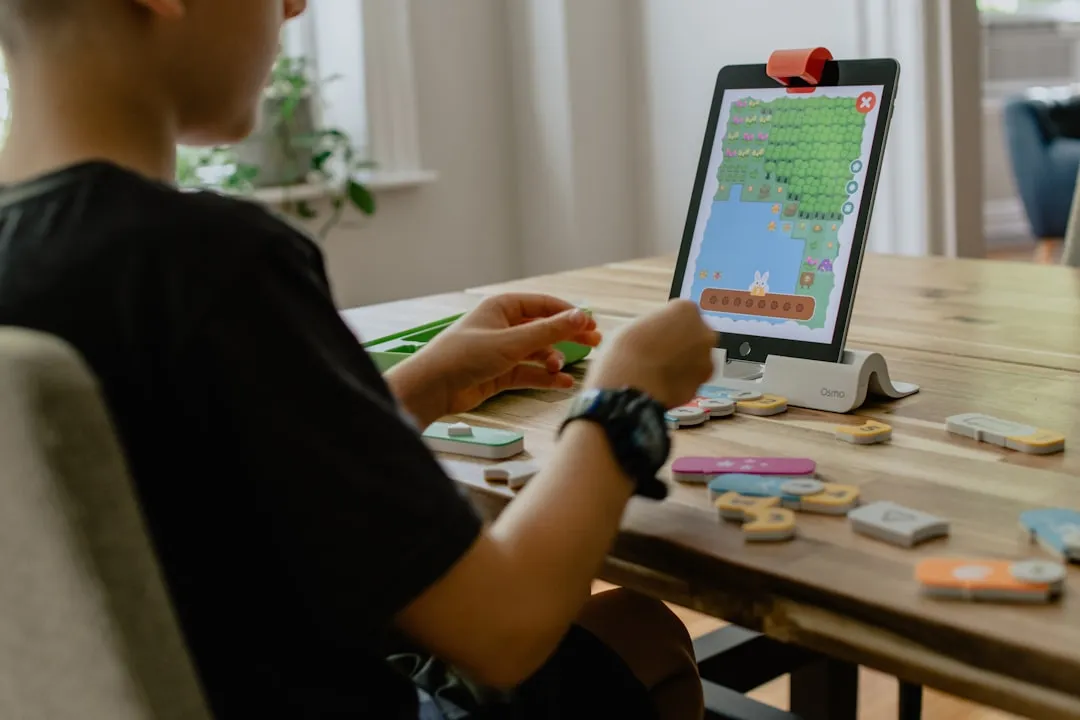
You know what's fascinating about AR edutainment? For years, everyone's been promising that this tech would revolutionize how kids learn, but most attempts felt more like tech demos than actual education. Now here's Osmo making another ambitious push into this space, and honestly, they might be onto something genuinely different this time around.
The company's camera-based system continues to bridge physical play with digital interaction, using a reflector attachment that enables devices to track real-world objects and translate them into responsive on-screen experiences. What makes this latest attempt particularly noteworthy is how they're addressing the core challenge that has plagued AR edutainment: creating genuinely engaging content that doesn't feel like disguised homework.
The technical foundation remains elegantly simple yet effective. Osmo's approach relies on computer vision technology that captures physical object movements in real-time, allowing children to manipulate tangible game pieces while seeing their actions reflected digitally. This hybrid model has proven successful in classroom environments, with over 30,000 classrooms currently using Osmo to supplement traditional teaching methods. The system's compatibility across both iPad and Fire Tablet (and some iPhone models) demonstrates a pragmatic approach to device accessibility that many AR startups have struggled to achieve.
Rather than requiring families to invest hundreds in specialized hardware that might become obsolete, Osmo leverages devices people already own with a simple, durable reflector attachment that takes minutes to set up—exactly the kind of friction-free adoption that educational technology desperately needs.
Why the "edutainment" balance actually works this time
The company's latest game offerings reveal a more sophisticated understanding of what keeps children engaged beyond the initial novelty. Take their Pizza Co. game, which combines restaurant management with mathematical problem-solving by having kids fulfill customer orders using physical pizza toppings and currency pieces. What's clever here is how the game layers complexity—children start with simple pattern matching but gradually encounter challenges involving rent calculations, delivery charges, and profit margins. This progression feels organic rather than forced, addressing the common complaint that educational games often sacrifice fun for learning objectives.
The game mechanics create seamless educational transitions that feel natural rather than jarring. Kids start by simply matching pizza orders—pepperoni here, mushrooms there—but the system gradually introduces business concepts by having them flip the play mat over to access mathematical challenges. One parent noted how this physical action created a perfect bridge between the fun pizza-making and the number crunching, demonstrating how thoughtful design can make learning feel inevitable rather than imposed.
The Detective Agency experience takes a different approach, creating an interactive mystery game that incorporates real geographical locations like Rio de Janeiro while children track international criminals. The physical component—using a magnifying glass over detailed maps—adds a tactile element that pure digital experiences can't replicate. Sessions typically run 15-20 minutes, which aligns well with children's attention spans and parents' screen time concerns.
What's particularly effective is how this approach develops spatial intelligence and cultural awareness simultaneously. Kids absorb information about real cities, landmarks, and geographical relationships while staying focused on the narrative tension of catching criminals—the educational equivalent of learning by stealth rather than direct instruction.
The Math Wizard series: addressing pandemic learning gaps
Here's where Osmo's timing becomes almost uncanny. Their Math Wizard series emerged as research highlighted greater learning deficits in math compared to other subjects among K-8 students during COVID-19. The company's response was to create an eight-part series that makes mathematical concepts feel like adventure gaming rather than drill practice.
Now, I'll be honest—when I first heard about "Math Wizard," my initial reaction was skepticism. How many times have we seen companies slap a fantasy theme onto basic arithmetic and call it revolutionary? But the execution here demonstrates genuine pedagogical sophistication that surprised me.
The engagement metrics are compelling: 20,000 children solved over 3.5 million math problems within the first few months of the series launch. What's particularly interesting is how the games scaffold learning—the Amazing Airships title, for example, teaches equation balancing through airship construction, where children must balance lift (balloons) against weight (cargo) using mathematical principles. This concrete visualization of abstract concepts addresses a fundamental challenge in mathematics education.
The series spans grades 1-2, targeting that crucial foundational period where kids either develop confidence with numbers or start building math anxiety that can haunt them for years. Each game tackles different aspects—addition, subtraction, early multiplication concepts, and even introductory algebraic thinking. The Enchanted World Games, for instance, has kids creating power smoothies for athletes, using repeated addition as a foundation for understanding multiplication.
The real validation comes from educators who've integrated these tools into their teaching. One first-grade teacher in Texas noted how the games help students develop foundational math skills through visual reinforcement while building the confidence necessary for mathematical success. That's exactly the kind of foundation-building feedback you want to hear when addressing learning gaps.
What makes the hardware approach sustainable
Unlike many AR startups that require expensive, specialized hardware, Osmo's strategy leverages existing consumer devices with minimal additional components. The reflector system costs significantly less than dedicated AR headsets while offering enhanced sensory development through tactile manipulation of physical objects. This approach sidesteps the adoption barriers that have hindered other AR educational platforms.
The modular game design also creates a sustainable content ecosystem. Each game kit includes specific physical pieces—pizza toppings and currency for Pizza Co., maps and magnifying glass for Detective Agency—that work exclusively with their corresponding digital experiences. This creates natural expansion opportunities while maintaining the tactile elements that differentiate Osmo from purely digital alternatives.
The psychological impact of physical components extends beyond mere engagement—it connects to fundamental aspects of child development and learning retention. Research in cognitive science suggests that tactile manipulation helps with memory formation and conceptual understanding in ways that touchscreen interactions alone cannot replicate. When kids can organize game pieces, sort them, and even fidget with them while thinking through problems, they're engaging multiple sensory pathways that reinforce learning.
Parents report practical benefits beyond engagement metrics. Children can adjust difficulty settings independently, fostering self-directed learning, while the structured session lengths help families manage screen time effectively. The games also support collaborative play, improving social interaction and teamwork skills that pure digital experiences often lack.
Where AR edutainment goes from here
Osmo's refined approach suggests that AR edutainment success depends less on cutting-edge technology and more on thoughtful content design that respects both educational objectives and entertainment value. Their classroom adoption rate of over 30,000 educational institutions indicates that the hybrid physical-digital model has found genuine product-market fit in ways that purely digital or purely physical alternatives haven't achieved.
What's interesting is how this success challenges prevailing assumptions about AR in education. The industry has been obsessed with immersive, headset-based experiences that transport kids to completely virtual worlds. But Osmo's model suggests the real opportunity lies in augmenting the physical world rather than replacing it entirely—making learning more interactive without disconnecting children from tactile, collaborative experiences.
The company's focus on curriculum alignment—particularly their Math Wizard series designed for grades 1-2—demonstrates how AR can supplement rather than replace traditional educational methods. This evolutionary approach to educational technology integration may prove more sustainable than the revolutionary disruption narrative that many AR companies have pursued unsuccessfully.
Looking ahead, the real test will be whether this model can scale beyond early adopters to become a mainstream educational tool. The pathway from 30,000+ classrooms to widespread adoption requires demonstrating not just engagement metrics, but measurable learning outcomes that justify ongoing investment. However, with engagement data that would make any edtech company envious and genuine educator endorsement, Osmo seems well-positioned to prove that the most innovative approach to educational technology might simply be making learning genuinely fun while respecting how children actually develop and learn.



Comments
Be the first, drop a comment!