


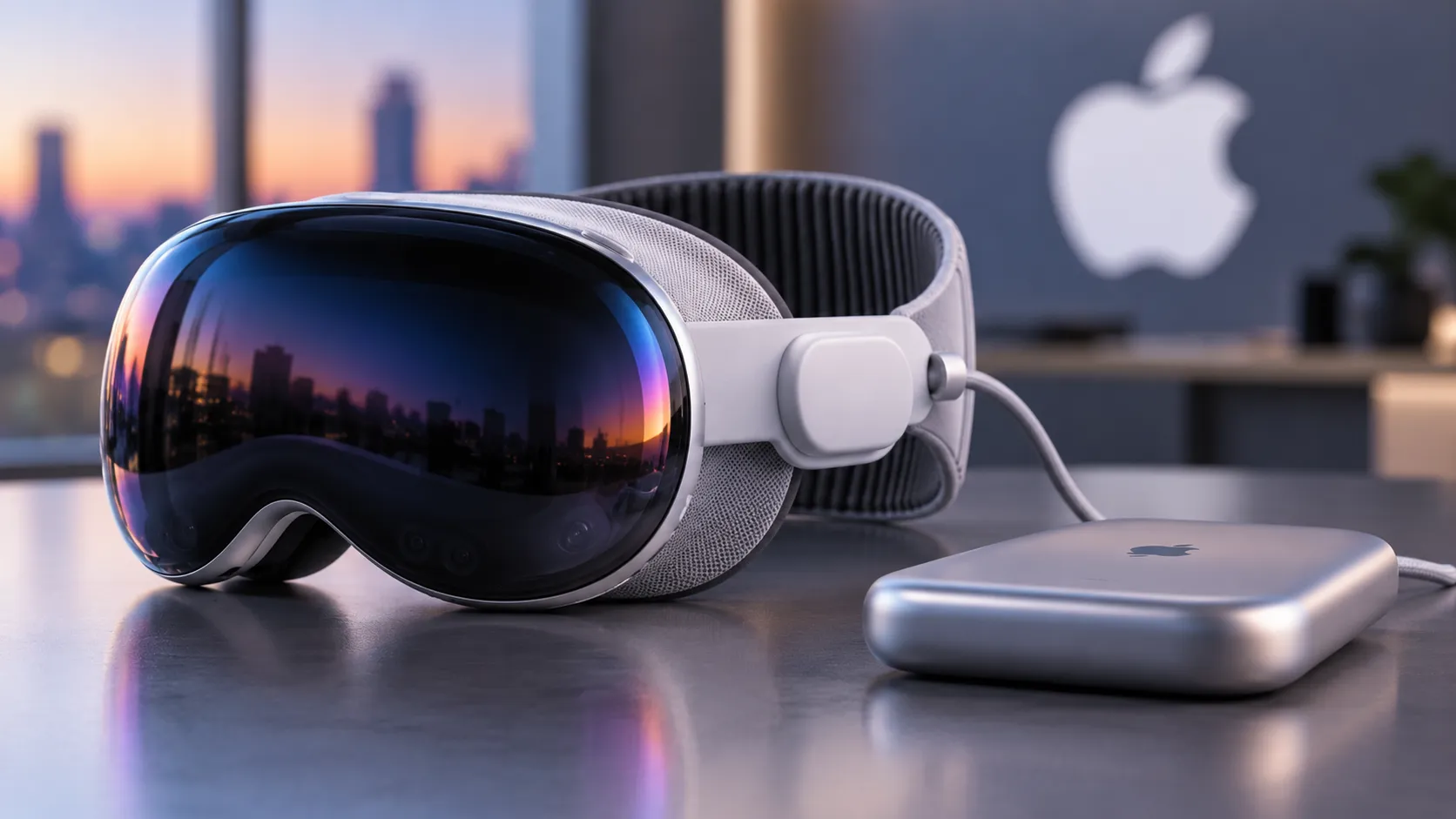
Apple's latest Apple's visionOS 26.4 documentation update has quietly introduced a game-changing capability that's about to transform how we think about high-performance applications on the Vision Pro. While most platform updates focus on incremental improvements, this release brings something fundamentally different: the technical foundation for truly demanding immersive experiences that were previously difficult on standalone VR hardware.
The breakthrough centers around a new technology called Foveated Streaming, which according to Apple's documentation allows visionOS applications to display high-resolution, low-latency immersive content from remote streaming sources. This isn't just another streaming protocol—it's a sophisticated approach that could redefine what's possible when you combine local spatial computing with remote processing power. The timing couldn't be more significant, as it arrives alongside support for what's being called the "world's most advanced flight simulator" on Apple's mixed reality platform.
Here's what makes this particularly compelling: applications like Microsoft Flight Simulator, X-Plane 12, or Laminar Research's professional-grade simulators—which typically require dedicated gaming rigs with high-end GPUs—could potentially deliver, if developers build support their full computational complexity while leveraging the Vision Pro's unmatched spatial interface capabilities. We're talking about the difference between simplified mobile-style experiences and true professional-grade simulation tools.
What makes Foveated Streaming a technical breakthrough?
The core innovation behind visionOS 26.4's new capabilities lies in how it intelligently combines local and remote rendering. Traditional streaming solutions force you to choose between local processing limitations or complete dependence on remote servers. Apple's Foveated Streaming technology changes this equation entirely by enabling hybrid rendering scenarios that weren't previously feasible.
Apple's technical documentation reveals that "Foveated Streaming enables visionOS apps to display high-resolution, low-latency immersive content from streaming endpoints." But what's really clever is how this works in practice. The system allows Vision Pro to display visionOS spatial content alongside streaming content seamlessly. The flight simulator example Apple provides is particularly telling: applications can now render a detailed cockpit interface using the device's native RealityKit capabilities while simultaneously streaming processor-intensive landscape visuals from a remote computer.
The technical elegance here is remarkable. By leveraging the Vision Pro's advanced eye tracking hardware, the system can determine precisely where you're looking and allocate the highest resolution streaming bandwidth to that specific area. Meanwhile, your peripheral vision receives lower resolution content that your brain naturally won't notice as much. This isn't just bandwidth optimization—it's a fundamental rethinking of how immersive content can be delivered efficiently across different computing resources.
What's particularly impressive is how Apple appears to have addressed the latency challenges that typically plague streaming solutions. The hybrid approach keeps interaction-critical elements—like reaching for cockpit controls or manipulating spatial interface elements—running locally at native frame rates, while streaming the computationally expensive but less time-sensitive background rendering. Based on the documentation, the system can maintain the sub-20-millisecond response times essential for believable hand tracking while handling remote content streams simultaneously.
PRO TIP: The key insight here is that foveated rendering combined with hybrid processing creates a multiplicative effect. Not only are you saving bandwidth by focusing on where users actually look, but you're also optimizing which computing resources handle which aspects of the experience based on interaction requirements rather than just processing demands.
How this transforms gaming and simulation possibilities
The implications for high-fidelity gaming and professional simulation applications are massive. Before visionOS 26.4, developers faced a stark choice: create experiences limited by the Vision Pro's mobile-class processing power, or abandon the platform entirely for applications requiring serious computational muscle. This new streaming architecture eliminates that compromise entirely.
Flight simulation showcases this perfectly because it represents the intersection of spatial computing strengths and computational intensity. The hybrid rendering approach described in Apple's documentation demonstrates exactly how this works: "On Apple Vision Pro, Foveated Streaming allows you to display visionOS spatial content alongside streaming content. For example, a flight simulator app can render a cockpit using RealityKit, and stream a processor-intensive landscape from a remote computer to the device."
Consider the technical requirements: modern flight simulators need to render landscapes spanning hundreds of miles, simulate real-world weather patterns affecting millions of particles, calculate complex aerodynamics in real-time, and manage air traffic systems with thousands of variables. That's easily 10-20 teraflops of computational demand—far beyond any mobile processor. But the cockpit experience—flipping switches, adjusting trim wheels, reading instruments—is where spatial computing delivers something impossible on traditional screens.
This architectural approach opens doors for applications that were simply off-limits before. Autodesk's professional visualization tools could stream photorealistic architectural renderings while maintaining spatial manipulation capabilities. Medical simulation platforms like 3D Organon or Complete Anatomy could handle complex physiological modeling remotely while preserving the tactile examination experience locally. Engineering applications from companies like Dassault Systèmes could combine their computationally intensive CAD rendering with the Vision Pro's precision spatial manipulation tools.
The economic implications are significant too. Instead of requiring users to own high-end PC setups, developers can potentially offer cloud-based computational resources as part of their service model, dramatically expanding their addressable market while delivering superior experiences.
What this means for developers and the broader ecosystem
For developers, visionOS 26.4's Foveated Streaming support represents both an opportunity and a paradigm shift. The technical architecture requires fundamentally rethinking application design around a distributed processing model that wasn't possible before.
From a practical standpoint, developers will need to architect applications with clear separation between spatial interaction layers and computational processing layers. Based on Apple's documentation patterns, this likely involves new RealityKit APIs for managing local spatial content alongside streaming content integration points. The development workflow becomes more complex—you're essentially building for two different execution environments that need to coordinate seamlessly.
The infrastructure requirements are substantial. Successful applications will need robust content delivery networks, low-latency streaming endpoints, and sophisticated bandwidth management. This could favor development teams with existing relationships to cloud computing providers like AWS, Azure, or Google Cloud, or companies that already operate streaming infrastructure.
But here's what's particularly interesting for enterprise adoption: industries that were intrigued by spatial computing but couldn't compromise on computational performance now have a clear technical path forward. Aerospace companies training pilots on multimillion-dollar aircraft, medical schools teaching complex surgical procedures, or engineering firms collaborating on massive infrastructure projects can finally leverage the Vision Pro's spatial capabilities without sacrificing the computational sophistication their applications demand.
The ripple effects could reshape the entire mixed reality development landscape. If Apple demonstrates that hybrid local-remote processing delivers superior experiences to purely local approaches, competing platforms will likely need to develop similar capabilities to remain relevant for professional applications.
The bigger picture: redefining spatial computing's potential
The introduction of Foveated Streaming in visionOS 26.4 signals Apple's recognition that the future of spatial computing isn't about choosing between local and remote processing—it's about intelligently combining both. This update positions the Vision Pro not just as a standalone mixed reality device, but as a sophisticated spatial interface that can tap into more powerful external computational resources when needed.
The flight simulator implementation serves as a compelling proof of concept, but the real excitement lies in what comes next. As developers begin exploring the possibilities enabled by hybrid local-remote rendering, we're likely to see entirely new categories of immersive applications that simply weren't feasible before. Think about applications that combine the Vision Pro's spatial awareness with the processing power of entire server farms—scientific visualization tools that can render molecular dynamics simulations in real-time, or collaborative design environments where teams can manipulate photorealistic 3D models that would typically require dedicated workstations.
What's particularly clever about Apple's approach is how it preserves the Vision Pro's core strengths while eliminating its most significant limitation. The device's incredible spatial tracking, hand and eye interaction capabilities, and seamless mixed reality integration remain central to the experience. But now those capabilities can be paired with computational resources that rival high-end workstations or even supercomputers.
The Vision Pro's evolution from an impressive but somewhat limited spatial computer to a gateway for truly demanding mixed reality experiences represents exactly the kind of platform maturation that could drive broader market adoption and developer investment. We might be looking at the moment when spatial computing transitions from an interesting novelty to an essential tool for professional applications that simply can't be done effectively any other way. And for developers willing to embrace this hybrid processing paradigm, the computational ceiling just got raised to virtually unlimited heights.



Comments
Be the first, drop a comment!