


Samsung OLED Microdisplay Smart Glasses: What the Display Week Demo Really Showed
At SID Display Week in Los Angeles this week, a Samsung Display subsidiary showed off a glasses frame threaded with eMagin OLED microdisplays that project detailed, transparent video overlays into both lenses simultaneously. The image quality was striking. The frame was bolted to a table.
Nobody at the show could wear the device. The micro OLEDs were mounted in a fixed frame that attendees stood behind and looked through, sidestepping every real-world constraint that defines consumer wearables: weight, battery life, heat, onboard compute, as PCMag reported this week. Samsung Display acquired microdisplay maker eMagin in 2023, and the Display Week showing is the first public signal of what that acquisition was meant to enable.
The demo is best understood as a component pitch. eMagin and Samsung Display are signaling to device makers that they have a display engine capable of competing in AR optics. What the demo does not answer is whether anyone has figured out how to turn those components into glasses a person can actually wear.
What Samsung Display smart glasses actually showed
The demo frame ran 0.62-inch OLED microdisplays at 1,280 × 1,024 resolution, exceeding 20,000 nits of peak brightness and refreshing at up to 85Hz. The panels carry a claimed 99% color gamut, though the actual demo output skewed noticeably yellow, which PCMag noted was a calibration choice rather than a hardware ceiling.
The brightness figure is the one that matters most for AR. Transparent displays compete directly against ambient daylight passing through the same lens; a dim image simply washes out. Geometric reflective waveguide designs, which use semi-transparent mirrors to bounce light with minimal loss, already enable displays that remain visible outdoors in bright daylight and can run for several hours on a charge performance advantages over diffractive designs that heise documented last year. The Samsung/eMagin design uses micro OLEDs tucked into the frame that beam light into the lens edges, redirected toward the eye through etched patterns on the glass. Available reporting describes that etched-lens architecture, but does not confirm which waveguide subtype it belongs to.
A looping concept video showed overlays for video playback, messaging, and food nutrition lookup, rendered as transparent digital layers on a live view of the room, according to PCMag. The applications are plausible. What the fixed-frame format made impossible to evaluate: field of view, eyebox size, power draw, thermal output under sustained use, and image stability when a wearer's head moves. A 20,000-nit OLED in a bolted display case confirms the panel can produce that output. It says nothing about what happens when a battery, a processor, and a human head are attached.
How waveguide optics work, and why manufacturing is the hard part
A waveguide display has two components: a light engine hidden in the frame that generates a tiny image using a microdisplay, and a waveguide lens that carries that light to the eye while staying transparent to the real world. The engineering challenge is not generating the image. It's getting that image from the lens to a moving eye, cleanly, efficiently, and repeatedly at scale.
Reflective waveguides avoid the color-accuracy problems tied to diffraction and deliver optical efficiency close to ten times higher than diffractive alternatives, IDTechEx found earlier this year. That efficiency gap is what makes outdoor readability and multi-hour battery life achievable in shipping products. Glass-substrate reflective waveguides are built from dozens of precision components, each requiring gluing and polishing, which creates serious yield challenges at scale, per IDTechEx. Diffractive designs can produce thinner, more compact eyepieces despite their efficiency penalty, which is why they remain competitive. Form factor is not a secondary concern when the product has to look like eyewear people will put on their face.
Polymer substrates can reduce cost, weight, and improve durability compared to glass, but carry a lower refractive index. For a given lens thickness, that means a narrower field of view, IDTechEx noted. Every improvement to one parameter costs something elsewhere. There are no free variables in waveguide design.
The trade-offs every competitor has already made
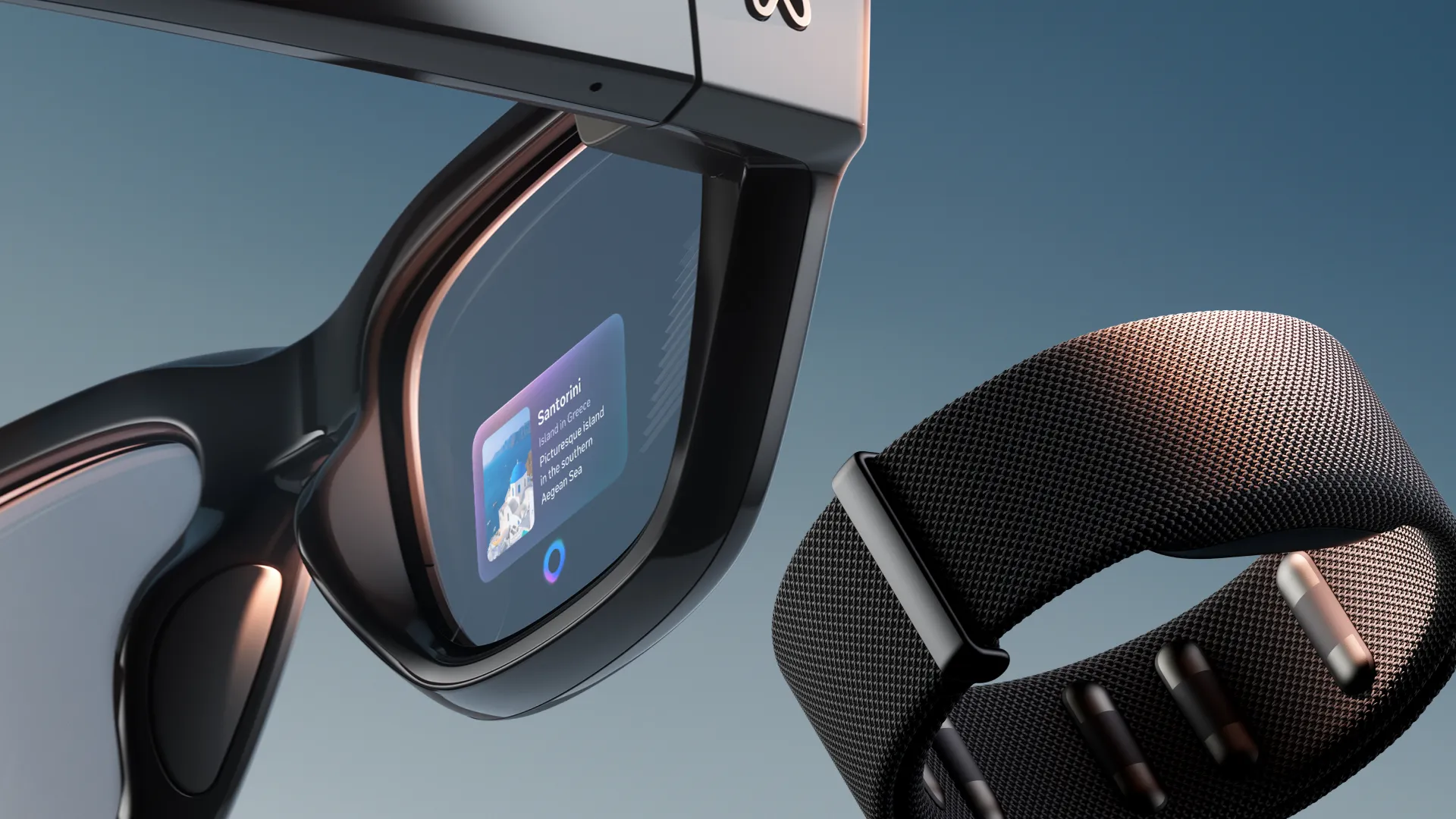
Meta's Ray-Ban Display is the clearest commercial reference point. It uses a geometric reflective waveguide supplied by Lumus and manufactured by Schott, projecting a 600 × 600 image into a single lens covering roughly 20% of the wearer's field of view, according to PCMag and IDTechEx. That's a small window by any measure, but it was chosen deliberately. The design is cheaper to produce, efficient enough to stay visible outdoors for several hours, and, practically speaking, the display is barely visible to people looking at the wearer, which matters for whether anyone will actually wear it outside, heise reported.
At the opposite extreme, Meta's Orion prototype used silicon carbide waveguides to achieve a 70-degree field of view, roughly 16 times the projection area of the Ray-Ban Display, per heise. Silicon carbide's high refractive index allows the waveguide to be thinner and lighter at large angles, but material availability and cost put Orion firmly in research territory, IDTechEx noted.
The Samsung/eMagin demo covers both lenses and runs at higher raw resolution than the Ray-Ban Display a meaningful step up in image presence, based on the specs reported by PCMag. Three constraints remain unanswered: field of view (no figure was disclosed), power consumption at sustained brightness across two high-output panels, and whether the waveguide optics can be manufactured at consumer-relevant cost. These are not details to be resolved later. They are the questions that have stopped previous AR glasses programs from reaching consumers.
eMagin is pitching the same micro-OLED technology toward military, medical, and industrial customers alongside its consumer AR pitch, PCMag reported. Those markets tolerate higher costs and different form factor requirements. The near-term commercial path for this display engine may run through enterprise before it reaches anyone's face on the street.
A credible display supplier, not yet a consumer product
Samsung Display and eMagin demonstrated display-industry-credible specs at Display Week. More than 20,000 nits on a sub-inch OLED panel is a real benchmark for transparent AR optics, and dual-lens coverage puts it ahead of the Ray-Ban Display's single-lens, 20%-of-field implementation on raw image presence, based on figures PCMag reported. That's worth noting.
The manufacturing cost of high-quality waveguide optics remains the industry's most durable bottleneck. Glass substrates deliver the best image quality but complicate production at scale; polymer alternatives reduce cost at the expense of field of view, per IDTechEx. The demo offered no data on how Samsung/eMagin intends to resolve that.
Whether Samsung Electronics adopts this display stack for its own smart glasses, reportedly slated for later this year, remains publicly unresolved, according to PCMag. Samsung Display was spun off from Samsung Electronics in 2012, and the two companies have operated independently for over a decade. Internal alignment is not automatic. The Display Week demo establishes Samsung Display and eMagin as credible suppliers to the AR display market potentially including their own corporate sibling. It does not establish them as a company close to shipping consumer smart glasses. The components are ahead of where they were. The product that would use them remains hypothetical.





Comments
Be the first, drop a comment!