


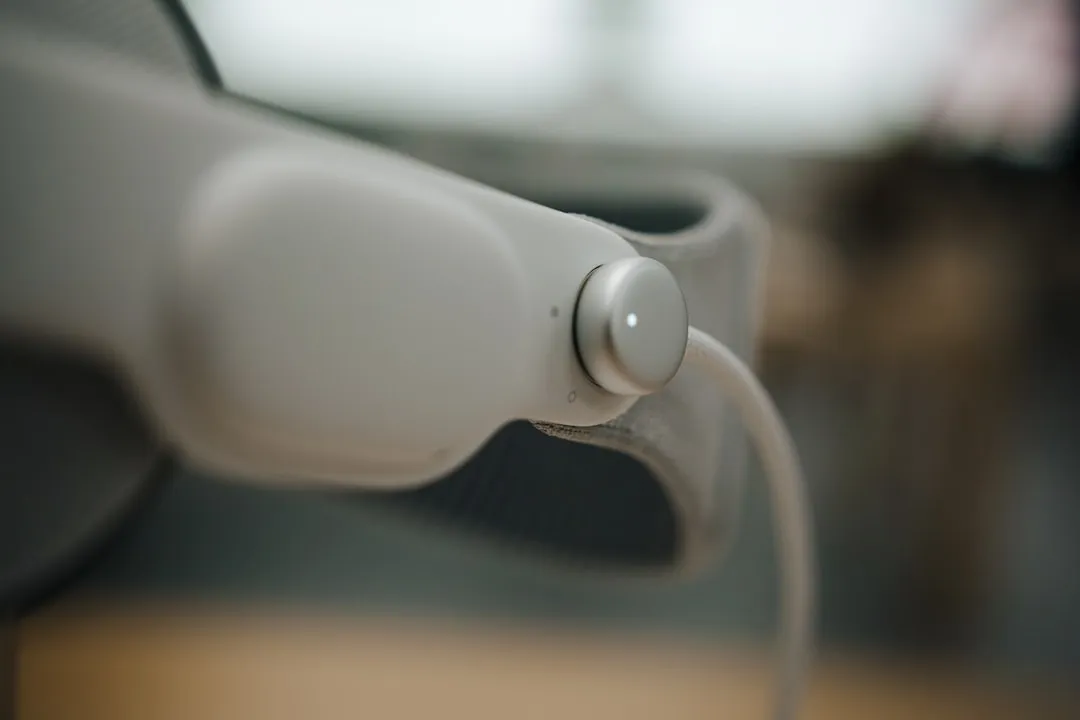
Apple has added a power wheelchair control feature to Vision Pro, letting users operate a compatible chair using only their gaze. The announcement was published in Apple's newsroom earlier this May, and it extends the headset's existing eye-tracking hardware into physical assistive mobility. At launch, Apple Vision Pro wheelchair control is limited to the United States and works with exactly two drive-system partners. Many technical specifics remain undisclosed.
The feature is immediately relevant to three groups: Vision Pro users with limited motor function, power wheelchair users who rely on alternative drive systems, and clinicians evaluating gaze-based mobility options. For everyone else, it's a signal about where mixed-reality hardware is heading, and how far it still needs to go.
What Apple actually announced about Vision Pro wheelchair control
Apple describes the new capability as a "responsive input method" that uses Vision Pro's precision eye-tracking system to control compatible alternative drive systems via Bluetooth or wired connection. The same gaze infrastructure that lets wearers select menus and scroll through spatial interfaces can now output commands to a compatible wheelchair. That's the extent of what Apple has publicly confirmed about the mechanism.
What Apple has not disclosed is how the control model actually works. Whether the system uses directional dwell-gaze, a selection-based overlay interface, or some other input scheme is not described in any available source. For anyone evaluating whether this suits their specific mobility needs, that's not a minor omission. The difference between a dwell-gaze model and a discrete selection model has real consequences for usability, fatigue, and error tolerance.
Apple does say the eye-tracking system requires no frequent recalibration and performs across a variety of lighting conditions, per the same announcement. For a system that physically moves a person through space, stability under varied conditions is table stakes, not a selling point. Apple is describing the minimum viable bar, not performance above it.
The eye-tracking architecture has been building toward this kind of use for a while. For users with strabismus, Vision Pro's accessibility settings already allow gaze navigation to be remapped to a single dominant eye or replaced entirely with hand gestures, as documented by a visually impaired UCSF grad student writing about the headset in early 2024. Prescription lens inserts from Zeiss register the wearer's Rx and use it to correct both screen rendering and eye-tracking artifacts, per the same account. The wheelchair feature sits on top of that same underlying system.
Starting with visionOS 26, users can save their eye and hand tracking data, vision prescription, and accessibility settings to an iPhone and carry them to a different Vision Pro headset. For assistive users, that means not starting from scratch when switching devices or sharing a headset with a caregiver.
Who can use Vision Pro power wheelchair control today
Launch compatibility is limited to Tolt and LUCI alternative drive systems in the United States, supporting both Bluetooth and wired connections, per Apple. Apple has said it will continue working with developers to expand drive-system support over time, but no additional partners, timelines, or eligibility criteria have been disclosed.
The addressable population right now is narrow: U.S.-based power wheelchair users who already have, or can obtain, a Tolt or LUCI drive system and a Vision Pro headset. Vision Pro retails at $3,499 as of this writing. Compatible alternative drive systems add cost on top of that. Apple has not published pricing for a complete qualifying setup, and no public information is available about whether insurance, Medicare, Medicaid, or assistive technology funding programs will cover any portion of either component.
The technical achievement is real. The gap between who can benefit from this and who can actually access it is also real. That expansion roadmap is where the more consequential reporting will happen.
What Apple hasn't said about safety and real-world performance
Apple has not publicly addressed latency, fail-safe behavior, emergency stop mechanisms, or any regulatory or clinical review the feature may have undergone. For a system that moves a person through physical space, those are not secondary questions.
"Responsive" and "works across lighting conditions" are Apple's own characterizations, from its announcement earlier this month. Neither claim has been independently quantified. Performance in crowded, outdoor, or unpredictable environments, precisely the conditions where a mobility device gets used, remains documented only through Apple's own framing.
No wheelchair user testing accounts, case studies, or third-party performance data appear in any source reviewed for this article. The experiential record for this specific feature is currently empty. The 2024 account from the UCSF grad student documents Vision Pro as an assistive device for vision-related use, but it predates the wheelchair feature and covers a different domain entirely. It supports the credibility of the underlying eye-tracking architecture, nothing more.
The control model question carries safety implications, not just usability ones. How a user steers, slows, stops, and recovers from a misread gaze input determines whether this is a workable assistive tool. Apple hasn't said.
Where this fits in Apple's accessibility approach
The 2026 accessibility rollout is broader than the wheelchair headline. The same rollout includes image description, on-device captioning for any video, natural-language voice navigation, and reading support for complex documents. Wheelchair control is the highest-profile item, but the package covers a range of disability categories.
The pattern stretches back at least three years. Apple's 2025 accessibility slate extended Vision Pro's Zoom feature to let users magnify their physical surroundings through the headset's main camera, and Braille Access brought full-featured braille note-taking to Vision Pro as an integrated cross-device experience.
The 2024 cycle introduced Eye Tracking across iPhone and iPad, tied to Global Accessibility Awareness Day as well. Annual releases timed to the same event suggest deliberate platform strategy rather than isolated drops, though the gap between announcement and meaningful real-world reach has been a recurring issue across the category.
What to watch for next
The confirmed facts from Apple are these: Vision Pro's eye-tracking system can be used to control compatible alternative drive systems from Tolt and LUCI in the U.S., does not require frequent recalibration, and holds up across lighting conditions. Eye and hand data, prescription settings, and accessibility configurations can travel with a user to any Vision Pro via iPhone. Those are meaningful capabilities.
What no published source has yet established: how the control model works, how the system behaves under failure conditions, whether independent safety testing has taken place, and how ordinary people are expected to afford the hardware required to use it.
The evidence that would move this from a credible first version to a real assistive platform is specific: additional drive-system partners named and launched, international availability, published clinical or safety data, and some form of affordability pathway that doesn't treat $3,499 as a reasonable entry point for disability access. The technical capability is real. The access question is still open.



Comments
Be the first, drop a comment!