


Smart glasses have crossed a threshold. They look normal, sell in volume, and the market has a clear trajectory. What the category lacks is a settled answer to a deceptively simple question: who controls what runs on them? The debate over open platform smart glasses is no longer theoretical. Three competing models are already shipping, or nearly so, and the architecture decisions being made right now will determine which platforms developers build for and which devices people actually use.
Global XR device shipments grew 44.4% year over year in 2025, driven almost entirely by smart glasses rather than VR or MR headsets, according to IDC's March 2026 tracker. IDC projects 26.5% CAGR through 2030, with display-enabled glasses expected to surpass VR and MR headsets in shipment volume by 2027. As supply chain and IP constraints slow hardware differentiation, IDC argues software, services, and onboard AI will become the primary differentiators across the category.
This analysis focuses specifically on display-enabled smart glasses. That's where platform control is most consequential and where competitive fault lines are sharpest. Non-display glasses matter for market volume; they're not where the platform battle will be decided. The argument here isn't that open platforms will win — the evidence doesn't support that cleanly. It's that software control is becoming the real fault line, and the model that pairs meaningful developer access with credible privacy architecture will hold the strongest long-term position once display glasses reach scale.
Open vs closed smart glasses: what "open" actually means in practice
Before evaluating the three competing models, it's worth establishing what "open" and "closed" mean in observable, product-level terms rather than as marketing claims.
A working definition runs across four criteria: whether developers can publish apps broadly without special partnership status; whether users can install, remove, or replace functionality, including core features; whether apps and data are portable across hardware from different makers; and who controls what the device's AI functions collect and store. By those criteria, "open" is not binary. It exists on a spectrum, and no current smart glasses platform sits at either extreme.
The practical stakes are clearest at the software distribution layer. Even Realities launched Even Hub in early April 2026, giving G2 users access to more than 50 third-party apps with the ability to uninstall even core features, a degree of user control that Meta's glasses don't currently permit. At the OS layer, Google's Android XR is attempting to establish a shared spatial computing platform spanning Samsung, Lenovo, and other hardware partners, built on the OpenXR 1.1 standard, a deliberate multi-vendor design that contrasts with single-manufacturer OS strategies. Google released Android XR SDK Developer Preview 3 in December 2025, shipping developer tools including Jetpack Projected and Compose Glimmer alongside a hardware emulator, specifically to seed the ecosystem ahead of consumer device launches.
One dimension goes beyond apps: data control. What an AI-equipped, camera-and-microphone-equipped wearable does with what it sees and hears isn't a secondary concern—it's inseparable from the platform question. A platform that treats AI data processing as mandatory and opaque is making a platform choice as consequential as any app store policy. The four sections that follow evaluate each model against all four dimensions.
Three platform models, evaluated on the same terms
Meta: dominant, curated, and moving slowly toward openness
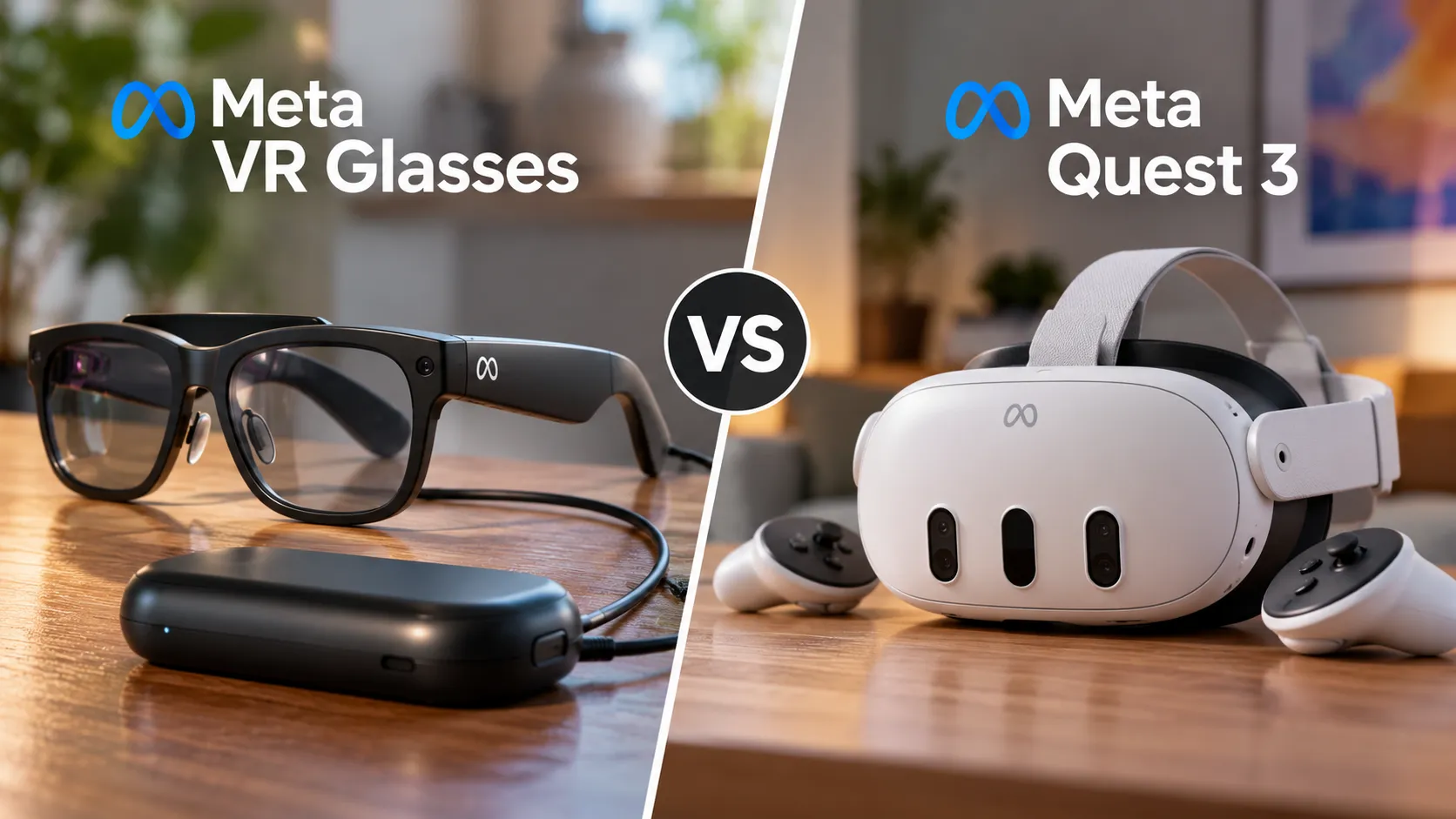
Meta controls somewhere between 72% of XR device shipments, according to IDC, and 82% of smart glasses shipments. The difference reflects the measurement window and category scope, but either figure represents near-total dominance. Meta sold roughly seven million Ray-Ban units in 2025, approximately double the prior year.
On developer access, users don't download third-party apps. They toggle approved "experiences" on or off. They cannot remove core features, and cannot change the AI wake word from "Hey Meta," per Lifehacker's reporting this week. Meta launched its Wearables Device Access Toolkit in developer preview in December 2025, granting access to camera, audio, and sensor capabilities, but public publishing remains restricted to select partners, with broader availability expected later this year. On data control, Meta updated its Ray-Ban privacy policy effective April 29, 2025, removing the option to prevent voice recordings from being stored, according to a December 2025 Byteiota roundup of the policy change. AI data processing is effectively mandatory for users who want AI features. On portability, apps are tied to Meta hardware, and there is no cross-device play.
None of this necessarily reflects a permanent strategy. Yahoo Tech's April 2026 analysis suggests Meta may simply be waiting for display hardware to mature before expanding its distribution model, and the toolkit preview supports that reading. Meta is running a tightly controlled platform during early hardware development, with planned, if slow, movement toward developer access.
Even Realities: semi-open, privacy-conscious, and niche
Even Realities is estimated to be worth $10 million with roughly $3.3 million in annual revenue, less than one percent of the total market. Estimated G2 sales of 10,000 to 25,000 units are comparable in volume to Meta's own display glasses, but the scale gap is enormous.
On developer access, Even Hub is best described as Apple App Store-style semi-openness: curated review exists, but users can install and remove whatever they choose, including core features. On portability, apps are tied to Even's hardware, no multi-OEM play. Data control is where Even's hardware design makes its clearest statement: the G2 ships without a camera or microphone, a deliberate trade-off that sidesteps the most acute privacy concerns while delivering a functional display experience in a frame most people won't recognize as a smart device.
Even Hub is a proof of concept more than a market force. But it demonstrates something concrete: a semi-open app model for display glasses is technically achievable today, and it can coexist with privacy-first hardware choices.
Android XR: the most open in ambition, the least proven in the market
Google's strategy is to recreate for spatial computing what Android achieved in smartphones, an OS that lets multiple hardware makers compete while developers write once and reach all of them. Samsung confirmed its Android XR smart glasses for 2026 at its Q4 2025 earnings call, and Google has previewed fashion partnerships with Warby Parker and Gentle Monster for consumer-facing Android XR eyewear. The SDK's use of the existing pool of 3 billion active Android devices and transferable developer skills dramatically lowers the cost of building for the platform. IDC named Android XR as one of the forces that will accelerate adoption and intensify competition across hardware and AI platforms simultaneously.
Android XR still has no consumer display glasses on sale. It deserves more weight as a strategic challenger than as a present-day competitor. The open ecosystem argument rests on developer enthusiasm and a multi-OEM architecture, neither of which has been tested against consumer adoption at scale. The platform also enters a market where subscale challengers already exist: Xiaomi at 4.2% share, XREAL at 2.3%, RayNeo and Viture each under 2%, none of whom have cracked the platform problem either.
Privacy is a platform design choice, not a policy layer
The privacy dimension of smart glasses is sometimes treated as a regulatory concern bolted onto an otherwise technical platform debate. For face-worn devices with cameras, microphones, and AI assistants, that framing is wrong. Data architecture is platform architecture.
Meta's glasses are already under regulatory scrutiny. Contractors reviewing user footage encountered sensitive and intimate content believed to be accidental recordings without advance warning, according to FindArticles' March 2026 investigation. The UK Information Commissioner's Office has questioned whether the devices comply with privacy law; European data protection authorities have raised concerns about bystander consent. Some employers in finance, healthcare, and manufacturing now ban camera wearables on premises entirely. These aren't edge cases. There are constraints on where and by whom the glasses can be worn.
Google has explicitly identified social acceptance as an existential category risk. "Our belief is that glasses can fail based on a lack of social acceptance," a Google spokesperson told CNN in December 2025. The "Glasshole" stigma from the original Google Glass is not fully gone, and a more open app distribution model applied to camera-and-microphone-equipped glasses could amplify existing concerns rather than resolve them. More apps mean more surfaces for data collection, more potential for misuse, and more regulatory surface area.
The practical implication: a platform with broad developer access but weak data controls won't win the trust of the mainstream users that make a platform durable. Even Realities' camera-free hardware is one design response to this constraint. Google's public "leaned in on privacy" framing is another. Neither is complete, but both reflect an understanding that the platform question and the privacy question cannot be answered separately.
Who wins, and when the decision actually gets made
The near-term picture is straightforward. Meta's curated model will remain dominant through 2026. IDC forecasts another 33.5% growth in XR shipments this year, with most of it coming from non-display glasses where Meta's scale advantage is largest, and app ecosystem openness matters least. A closed platform with seven million devices in the field is simply more attractive for developers than an open one with tens of thousands, regardless of how favorable the SDK terms are.
The inflection point arrives when display glasses reach scale, which IDC places around 2027. At that point, hardware specs among competing devices are likely to converge further, the app ecosystem question becomes the primary differentiator, and the cold-start problem currently limiting Android XR's practical appeal begins to resolve. IDC's December 2025 forecast said it plainly: "Brands that fail to address design along with battery life and app ecosystems will struggle to gain traction." App ecosystems are already on the criteria list, they just don't determine outcomes yet.
History is instructive without being conclusive. Nintendo's strict NES quality controls and Apple's 63% U.S. smartphone share despite Android's greater openness are real precedents for curation outperforming breadth, especially early in a category's lifecycle. Both examples also involved hardware that consumers were already motivated to own. Smart glasses still have to clear the bar IDC identified: convincing someone who doesn't need prescription eyewear to wear glasses all day. Platform openness alone doesn't close that deal, but it is what keeps developers investing in a platform once the hardware does.
The next 12 months will tell a lot. Watch for three signals: whether Meta opens publishing beyond select partners, which would signal it's serious about competing on ecosystem rather than just distribution; whether Samsung ships Android XR glasses in consumer volume before year-end, which would give the open-platform argument its first real test; and whether Even Hub attracts enough third-party developers to grow beyond a boutique proof of concept. The first platform to combine broad app publishing, genuine user control, and defensible privacy defaults won't just win developers—it will define what every platform after it has to offer. That combination doesn't exist yet at scale. Whoever gets there first sets the rules.


Comments
Be the first, drop a comment!